




 The Mayor, Guy Loosmore, put ‘Parking provision in Marlborough’ onto the agenda for the Annual Parish Meeting (Monday, April 28) and called for an open discussion. Parking seems to have a permanent place on agendas ancient and modern, but this time the debate took a new turn.
And it generated more light than heat.
Alison Galvin-Wright, one of the dozen members of the public at the meeting, set the tone for the debate. She wanted parking “where people who come to work in Marlborough can afford to park”: “They serve Marlborough by working here.”
Her theme was taken up by Councillor Justin Cook: “People on minimum wages coming into town park on residential streets – they shouldn’t be penalised.”
He argued that the only way to cope with the problem was to provide more parking: “Then you can enforce restrictions and stop parking outside people’s houses.”
But where to find space for the parking? The Mayor thought a ‘park and ride’ solution should be investigated. He suggested the Council salt depot at the east end of the Salisbury Road business park could help.
Councillor Cook suggested finding parking zones ten minutes walk away from the High Street. And Nigel Kerton wanted better use made of the parking at the rugby and football clubs – a small charge per day could help the clubs’ finances.
Councillor Mervyn Hall was highly critical of the policy of restricting parking spaces for new housing developments in the strange belief that it will help cars ‘go away’: “Cars won’t disappear – we’ll still be driving them in a hundred years.”
He warned against residential parking schemes quoting the costs in Swindon (£35 a year for the first car and £75 for the second) – which only allows you to park and does not reserve a space.
“We need,” Councillor Hall said, “to create more cheap or free parking capacity.”
 The meeting searched around for places to put more parking away from the centre but close enough not to put people off coming to the town. Nigel Kerton pointed out that the town was surrounded by land that would never become available for car parking – such as the College to the west and Savernake Forest to the south-east.
On the spur of the moment Mr Kerton suggested buying a field from the Sangster family off the A346 for a ‘park and ride’ scheme. He thought this was the only viable space left around the town.
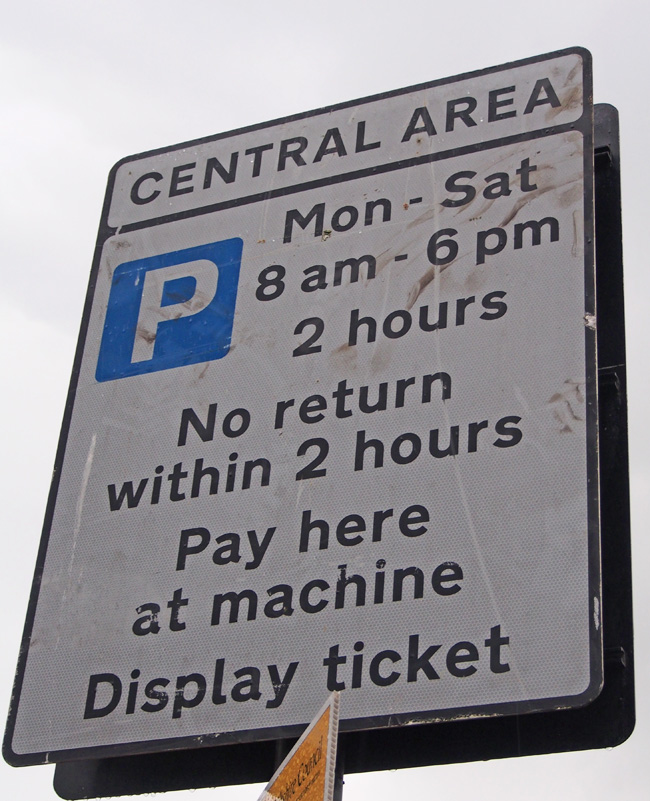
Returning to the costs of the Wiltshire Council car parks, Debbie Lorrain criticised the lack of proper notices explaining to visitors the difference between the fees for the short term parking (Waitrose or Hilliers Yard car park) and the long term (George Lane car park.)
Then the debate veered out of the car park onto the town’s roads and infrastructure. The idea of putting in a road south of the town between the A346 and the A345 was revived – and once again no attention was given to what it would do to traffic at the west end of the town.
Mayor Loosmore suggested that the town should consider taking over all the town’s car parking from Wiltshire Council. This might please Micky Dobie who wanted to see ‘one of the widest high streets in Europe’ kept free of cars.
The end result was a new working party on parking which would meet very soon.
|
Complaints about parking in Marlborough come in many forms. But retailers (who were not, of course, represented at the Parish Meeting) complain that the cost and/or lack of parking cuts ‘footfall’ – shoppers are put off coming to the town. Robert Hiscox now sees the parking problem from the point of view of a retailer (as an owner of the White Horse Bookshop) as well as a shopper coming to the High Street from Oare. He has complained to Wiltshire Council about the ‘aggressive’ nature of the wardens. “I suppose”, he wrote to the Council, “is is impossible to get Wardens to exercise common sense and to be trained to keep traffic flowing with the aim of encouraging people into town centres rather than punishing them and driving them off to the free parking in out of town outlets.” His point is echoed by many retailers MNO has been speaking to recently. The aggressive nature of Wiltshire Council’s attitude to parking and revenue collection was clearly seen when the recent storms prevented the market traders setting up one Saturday. They were still charged their daily market stand fees – and the Council got revenue when people started parking in the empty market spaces. The size of the problem facing the town council when idea comes up of taking over the parking from Wiltshire Council is clear and comes in columns of figures. In 2012-2013 the net revenue to Wiltshire Council from parking in the High Street was £99,826. Takings were £217,293, but the Council’s expenditure on wardens, ticket machines and so on was £117,826. The 2012-2013 figures for George Lane, Hillier’s Yard, Hyde Lane, Kennet Place and Polly Gardens taken together were: net profit £156,853 – takings £362,729 and costs £205,876. As if councils don’t get enough stick over parking fees, the RAC says that because councils’ ticket machines don’t give change, motorists are putting “up to £38,000,000 a year” into the machines buying parking time they don’t need. |
 Auction aims to complete payment for Aldbourne’s widely praised and popular Community Junction youth centre

