







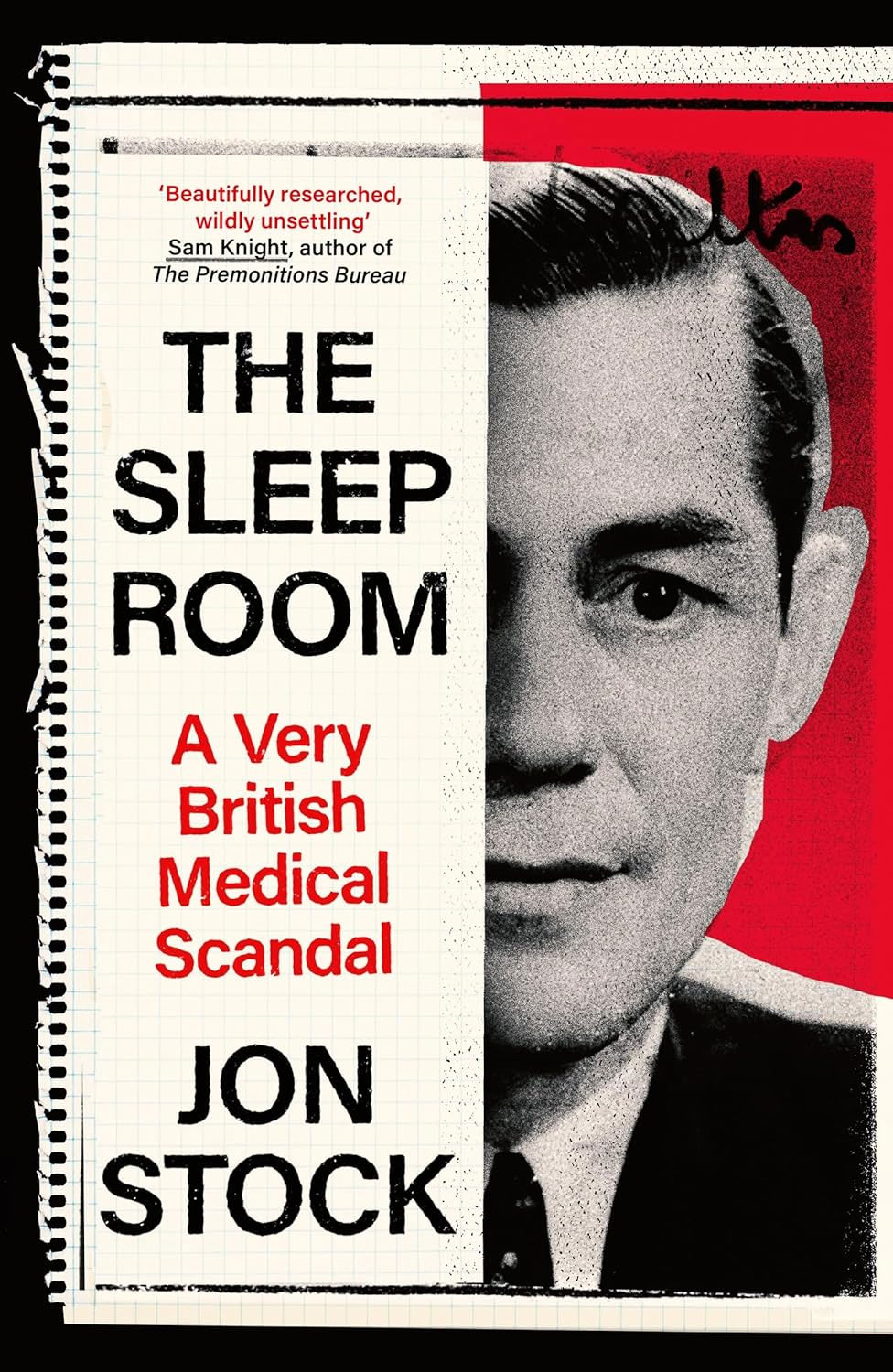
“Some people think I am a marvellous doctor. Others think I am the work of the Devil.” So said Dr William Sargant. That sets the tone for Jon Stock’s first foray into non fiction. William Sargant was the ‘Physician in Charge of Psychological Medicine’ at St Thomas’s, a role that he held between 1948 and retirement in 1972, spanning the entire ‘wild time’ of British psychiatry, and which he was leading from the front.
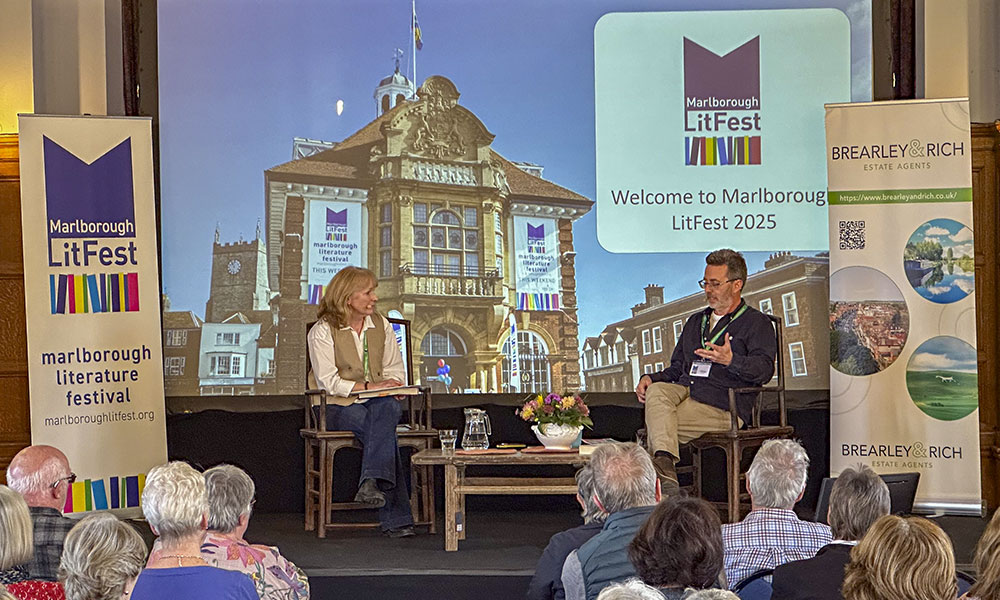
At the outset to his talk, Jon let the audience know that what he was discussing was ‘quite disturbing stuff.’ And ‘can be a bit upsetting’. his inspiration for this move into non-fiction came from LitFest, back in 2019 he interviewed Nathan Filer about his book ‘The Heartland’, about people who had suffered from psychosis and he was drawn to the structure, the subject and how the author had addressed this difficult area. And two years ago at LtFest there was Sam Knight, who had written ‘The Premonitions Bureau’, another non fiction book set in the 1960s about a ‘maverick’ British Psychologist, a John Barker, who believed in premonitions and precognition. That period was a ‘wild time’ in psychiatry and Jon looked around at various ‘notable’ in that field around that time and came across William Sargant.
Having been experienced in writing psychological thrillers, here was something quite real. There was plenty around about Sargant, he was a very high profile psychiatrist and one to whom many, particularly in the media would turn to for comment or advice. But to Jon there was also something else, deeper and darker, and almost that William Sargant was far from the positive force that he seemed, and could represent something entirely different but something that was possibly hiding in plain sight.
A ‘Marmite character’, and it was in a 1977 Sunday Times interview that he described himself as above in the opening line as ‘the work of the Devil’. He attracted lots of attention and comment throughout his career, a household name, regularly on the BBC, he divided opinions in a way that few other clinicians ever could or did. Now the opinion is far more critical and his actions and role is seen as being somewhat darker.
The ‘Sleep Room’ was at Waterloo. After a great deal of very detailed research across many sources, ‘The Sleep Room’ emerged, the title coming from Ward Five of London’s Royal Waterloo Hospital on the South Bank where Sargant worked. And the ‘Sleep Room’ was exactly that. A place of narcosis, a room where patients would be kept asleep (under sedation) for months, but woken four times each day for food and toilet, and then sent back to sleep again. He also employed ECT – electro-convulsive therapy – and various other ‘techniques’ such as lobotomy and insulin coma therapy as part of his catalogue of treatments. For Sargant, a mental health problem was a problem that could be addressed by a physical approach – psychosurgery, now more accurately termed neurosurgery for mental disorders. Across Sargant’s career Jon estimates that he could have been involved in the lobotomies of maybe five thousand patients, not all in the Sleep Room, but it was one of his almost normal procedures.
Jon’s book addresses six case studies, six patients – all women who endured the Sleep Room therapies, one of whom is actress Celia Imrie, who believes that she was part of the Sleep Room therapy in her teens, at about the age of fourteen. There were many others but Jon addresses just the six. Some patients (youngish girls) were there because their parents didn’t approve of their behaviour, and this was seen as acceptable treatment. So they underwent this ‘barbaric’ range of therapies, all based on sleep.
Jon talked with and interviewed patients who had undergone these treatments, those still alive. Some were willing to have their names used, others were given different names. It was their testimonies that are central to this book. Their stories are what mattered to Jon, no one listened to them before so this is opening new ground on an almost ‘sleeping’ subject.
Patients under Sleep Room therapy could be there for months. Sometimes they would be given ECT whilst asleep. He was probably the first to employ ECT in this country, and when asleep they couldn’t refuse permission for such treatment. This all started in the erly – mid sixties, around 1964, and was based on narcosis, sending patients into a deep sleep.
Jon notes that one of the reasons behind these ‘psycho-surgical’ methods was the effect of the war. PTSD (Shell Shock?) was common and the military couldn’t wait for talking therapies to help, so some short term procedures were called for and this quite possibly was one of the factors behind Sargant’s ‘physical’ approach. Back on the battlefield as quickly as possible. But this then ran into the non-military world.
Eventually it was Anthony Clare who really began to ‘put the boot in’ to Sargant in a fascinating book ‘Psychiatry in Defence of Itself’.
There is also the issue of Sargant and intelligence, CIA, British and brainwashing. Not to be addressed in any detail in this review, but certainly addressed by Jon in ‘The Sleep Room’, as it would appear that Sargant was influential in core aspects of the intelligence community. Experiments with patients on behalf of the intelligence services.
A fascinating talk, and fascinating book with Jon Stock bringing his fiction writing to bring what could be dry and almost academic subject to a very readable and accessible form.
‘The Sleep Room: A Very British Medical Scandal’ by Jon Stock – published by Bridge Street Press
 LitFest ’25: Anna Buruma – ‘Artistic Dress at Liberty & Co.’


