




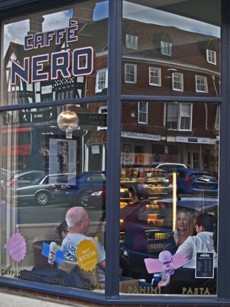
 Caffé Nero’s new outlet on Marlborough High Street opened on Monday (April 30.) By lunchtime, the café, which is on two floors of the building that used to house the Dash clothes shop, appeared to be doing good business.
As Marlborough News Online has reported, there has been a great deal of opposition to this move by Caffé Nero – especially as they have not yet had planning permission for change of use to A3 which a café or restaurant needs to have, and have gone ahead converting the shop and opening without that permission.
The window for objections to the planning application closed on Friday (April 27.) Sixty-nine contributions were made to the Wiltshire Council planning department website. All but one were against Caffé Nero’s application being granted.
It is not yet clear when Wiltshire Council’s Planning Committee will meet to rule on Caffé Nero’s change of use application. However the Council have left themselves in a very awkward position.
If they grant Caffé Nero retrospective permission for change of use how will they justify it? Especially when they have previously refused permission on a similar change of use application for premises close by in the High Street.
In June 2008 the owner of No. 10 the High Street – formerly the ‘Age of Elegance’ shop – applied to Wiltshire Council for change of use to allow a “restaurant/café” to be opened on the ground floor. This application was rejected the following month and in August the owner appealed the Council’s decision.
This appeal was also turned down. If Caffé Nero do get retrospective change of use permission from the Council – even if it is, perhaps, with reduced seating – how can the Council then continue to deny a similar application to the owner of No. 10? Especially as that building is, after extensive and costly renovations, still empty.
No. 10 is Grade II listed Building. But the fact that a building is Listed did not stop the Council allowing change of use for the Ivy House Hotel from a hotel serving the public to a hostel serving a private school. Nor, albeit much longer ago, did it stop the appropriate council allowing change of use for the Ailesbury Arms Hotel to become a bank and offices.
When the owner of No. 10 learned that Waitrose was opening a café within their retail premises in the High Street, she wrote to the Council planning department to ask why they had given Waitrose permission for this change of use and she had been refused permission for a similar café.
The Senior Planning Officer, Peter Horton, replied to her (24 June 2011): “Planning permission is not required for the cafe [sic] at Waitrose as the cafe element is ancillary to the main retail (A1) use. Hence no material change of use has taken place.” This concept of “ancillary” use appears to allow for a wide interpretation of the change of use rules.
Could Caffé Nero argue successfully that so long as they sell coffee beans and pastries, the ‘café element’ is ancillary to those retail sales and they therefore do not need change of use permission? And what might the Council feel able to allow as being ‘ancillary’ to Waitrose’s sale of fresh meat or fish?


