






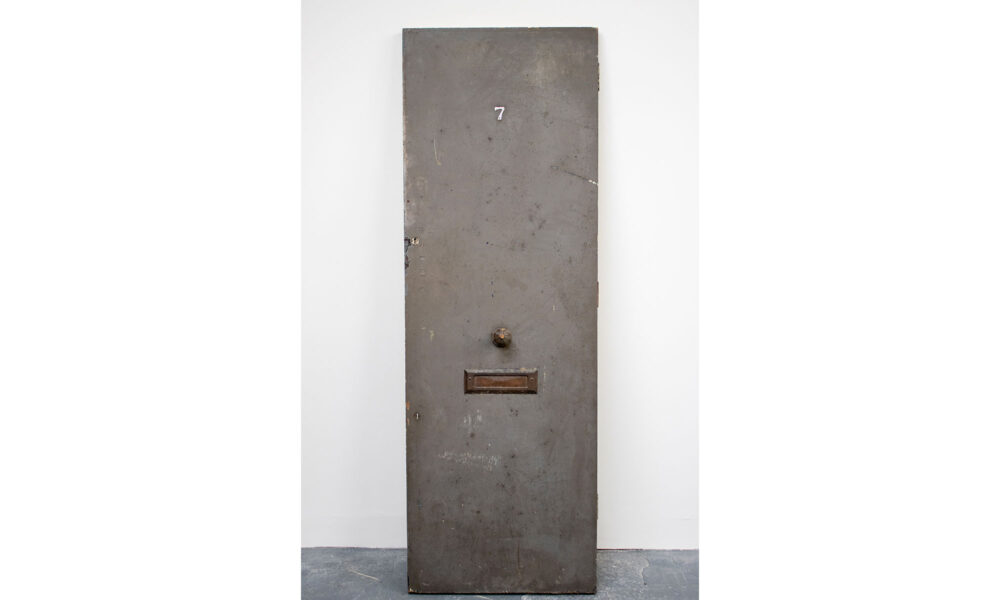
Does a door keep ‘a memory’ of those who have opened it or passed through? Of course not, a door is an inanimate object – or so we believe. But if the door that is currently in the possession of Grant Ford’s Winsor Birch fine art house and residing here in his Marlborough office could talk it would relate tales of the characters who helped influence the course of history of British art over the past century, as probably many of our greatest and most notable artists will have grabbed the door knob and pushed – or pulled – or even just posted something through the letter flap. The memories belong to the people who passed through it, but the door carries the marks of their passage.
What is this door? It is – or was – the door to the studio of one of this country’s greatest painters of recent years, Francis Bacon. It was the entry point to Bacon’s studio in Reece Mews, London, guarding that threshold from 1961 until the artist’s death in 1992 when it passed, with the rest of the studio to Bacon’s sole heir, John Edwards. Six or so years later it was given to the next door neighbour John Spero whilst the rest of the studio was lifted intact and rebuilt at the Hugh Lane Gallery in Dublin. But at present the door is leaning against a wall in Marlborough. But not for much longer.
Next week it travels from Marlborough up to London where it will be exhibited in Winsor Birch’s ‘Master Painters & Pioneers of the 19-20th Century’ at Gallery 8 in Duke St, and then to be offered for sale in a timed auction, supported by a handwritten letter of provenance from Bacon’s lover, John Edwards. How much? Pre-sale estimate for this tall, narrow, grey unrestored plank of wood that carries the patina of memories is between £40-60,000. Realistic? Who knows, only when the auctioneer’s gavel hits the block will we find out but it’s worth noting that three years ago Freddie Mercury’s garden door sold for £412,750 against an estimate of £15-25,000. If Bacon’s door gets anywhere near that price then this length of grey timber alone will be worth more than the rest of the many houses for which it could be the threshold back here in Marlborough.
Three of those who certainly crossed that threshold were the subjects of the three most expensive Bacon paintings ever sold at auction – Lucian Freud, George Dyer and John Edwards – the subjects of great Black Triptychs. One, Three Studies of Lucian Freud (1969) sold at Christie’s New York in November 2013 for $142.4 million, briefly the most expensive work of art ever sold at auction;
They were but three of many. Across the threshold guarded by this door in those thirty or so years ventured many of the great characters of British art and media, including David Sylvester, Lucian Freud, Frank Auerbach, the dealers from Marlborough Fine Art, the photographers John Deakin, Bill Brandt and Henri Cartier-Bresson, Melvyn Bragg with the South Bank Show film crew in 1985.
The eventual new owner will acquire not a piece of architectural salvage but a relic in the proper sense: an object made significant by sustained physical contact with one of the most important painters of the twentieth-century, every working day, for thirty-one years.
As Grant Ford tells, “In an era increasingly preoccupied with the material traces of artistic lives, the door survives not simply as architectural salvage but as an object of unusual psychological and cultural proximity to Bacon’s working world.”
 Last call for Youth Adventure Trust ‘Three Peaks Challenge’