





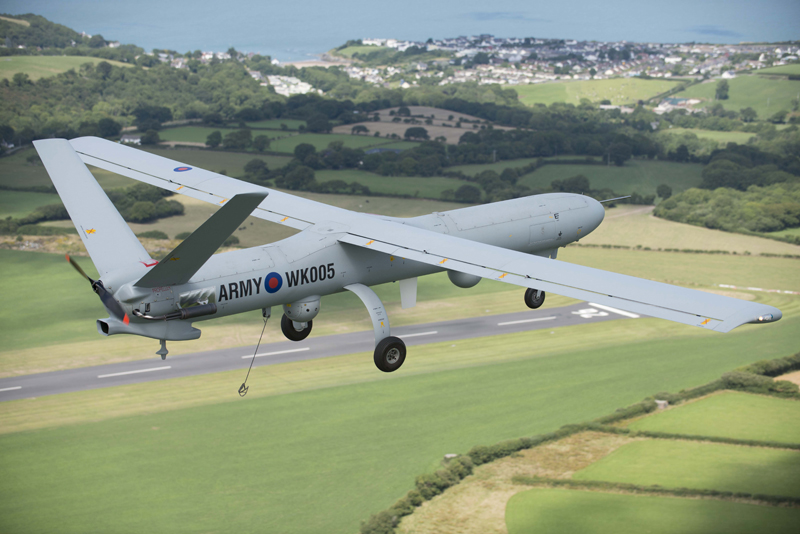
 Watchkeeper, the Army’s new ‘spy in the sky’ unmanned drone, has begun flying over Wiltshire this week, the first aircraft of its kind to use British skies for reconnaissance and surveillance training.
The huge unmanned air system (UAS) is being operated alongside helicopters and other aircraft from the Boscombe Down airfield in Amesbury by 1st Artillery Brigade ahead of trials in Afghanistan.
It has a wingspan of 35 feet, can fly at an altitude of up to 16,000 feet and has been designed to loiter over areas of interest for “significantly longer” than existing systems, providing clear surveillance pictures to troops on the ground.
And the aircraft is fitted with two sensors – a day and night camera which produces 24-hour high-definition images and a radar sensor, allowing it to see in all conditions.
These images are relayed in real time to a ground control station that acts as the aircraft’s cockpit – reducing the need to deploy troops to “potentially dangerous” situations.
Highly-skilled pilots started this week flying Watchkeeper in restricted airspace over the Ministry of Defence’s Salisbury Plain Training Area, overseen by military air traffic controllers.
The Army is due to begin its own training later this year.
Colonel Mark Thornhill, Commander of 1st Artillery Brigade revealed: “Watchkeeper is a state-of-the-art system coming in to service now. It can fly for longer, it flies off rough strips, it has better sensors, and is designed specifically to support worldwide operations in many different locations.
“Watchkeeper is a fantastic capability because it will allow us to provide real-time imagery back to the ground commander so that he can then take appropriate action depending on what he sees and what he learns from that imagery.
“Therefore, he will be able to perform in a much better fashion and make much better operational decisions based on the imagery we are providing to him.”
The Army currently operates four types of UAS in Afghanistan, which play an important role protecting soldiers on the ground by providing them with intelligence and reducing the need for deployment.
Watchkeeper will provide additional capability to the fleet — which has already completed 120,000 flying hours — once in service this summer.
Lance Corporal Christopher Gazey, a UAS analyst for 1st Artillery Brigade, said images produced by Watchkeeper will help give the Army better situational awareness.
“You can tell the difference between a man, a woman and a child, but obviously you are not going to do the Hollywood stuff of seeing what people are typing on their phones,” he explained.
“That’s not possible. We could be looking ahead of a friendly force convoy, they could be moving down the road and we could be looking 2-3km ahead of that convoy out of visible range of the troops.
We could be looking ahead to see if any insurgents were laying IEDs, if we observed that we could let the ground call sign know, they would stop and we’d essentially save lives there.”
Watchkeeper, manufactured by the Thales Group, has been tested in West Wales since 2010, and is nearing the end of its trials, is expected to take a “significant role” in future military campaigns.
Matt Moore, head of Thales UK’s UAS business, pointed out that once the aircraft reaches its operational altitude, it would be basically impossible to spot.
“It is that high up, the shape, the size, the low signature profile of the airframe, that it is very difficult to see among the terrain and the environment in the air,” he added.
 Top Marks for Pewsey Primary School – now on the way to Academy status


