




A press release earlier (13 March) from a PR Company (working on behalf of an accident compensation organisation) indicates that Wiltshire ranks #8 in the league for receiving additional Central Government funding to fix potholes. Across a single year Wiltshire gets £1,313.61 additional budget per mile whilst the average for the eighty four Local Authorities listed across the Country is £1,163.80. The press release states that this suggests the roads in Wiltshire are in much worse condition than those of other Local Authority areas. Possibly correct. But there is another question, not in the release, which is ‘what are Wiltshire doing with this additional budget’?
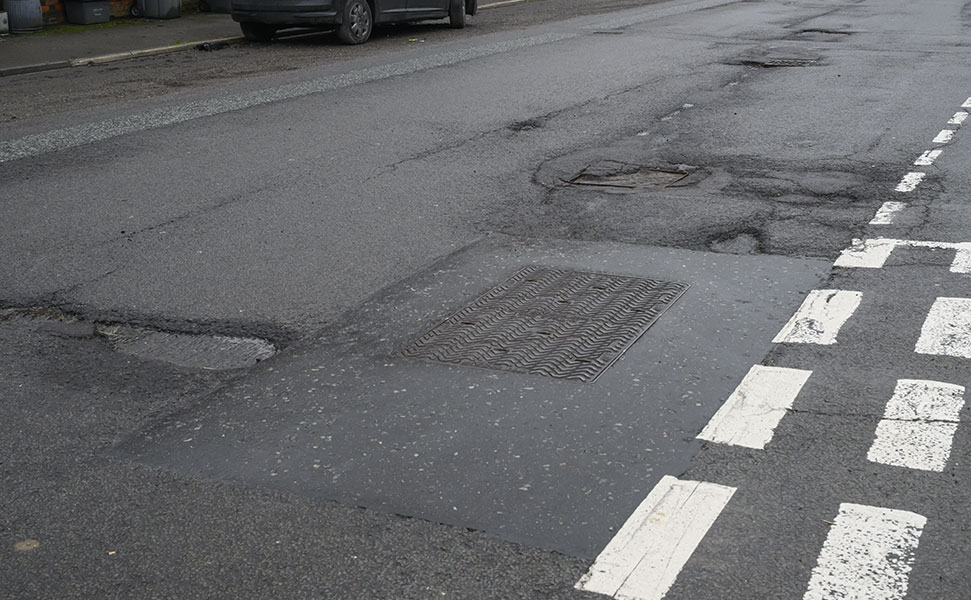
A very good and pertinent question. To be fair, Wiltshire Council do fix some (very bad) potholes reasonably quickly. Those that have cones placed around them, and are in the middle of a carriageway. As we recently witnessed in the middle of the High Street, and one particularly dangerous part of the Salisbury Road slalom. Those are the severe hazards. But there are so many long standing potholes, real ‘car breakers’ that get reported but ignored. Too many around Marlborough – using the ‘slalom’ stretch of Salisbury Road as an example – it’s been like this for a long time. We’ve had to live with it and bear the consequences. Anything happened? OK, apart from occasional very severe (coned) incidents, answer – No.
So potholes don’t get ignored, totally, but for Wiltshire the threshold of severity must be set pretty high. One Marlborough.news viewer informed us of a longstanding problem in Upper Fyfield. Not actually a ‘pothole’ per se, but where the road subsided after a hole had been dug and (sort of) filled in. This had been reported, our viewer inadvertently drove over it (soon after the repair but on a wet day so hole depth wasn’t visible) and the jolt caused the car exhaust to fracture. A claim was made, to their credit Wiltshire Council did compensate to the value of the repair (c£400), but two years on this defect is still there. Nothing has been done and our reader now drives carefully around it. How much would it have cost to fix? Probably less than that single compensation payment.
Wiltshire roads are – and have been – poorly maintained for some while. Even where major resurfacing has been done, within a year the holes start to appear where the topping crumbles away leaving the previous layer exposed and a hole of some 2″ depth. Wiltshire’s choice of resurfacing, called ‘dressing’, is meant to last ten years. Either it’s applied poorly or is the wrong selection of repair, but one or two years is the norm before it starts to break up badly.
Elsewhere it’s just poor or incomplete work when a hole has been dug by contractors for a Utility company. Where contractors have ‘finished’ their digging jobs, it would appear that no-one from Wiltshire inspects the finished job, or if they do inspect, those doing so close their eyes. As a recent letter from a reader pointed out, the job isn’t done properly. Has it always been like this? No.
How is this all calculated? The PR Co state: ‘Data was gathered on the additional funding allocated in local authorities’ budgets during the most recently available financial year for pothole repairs from GOV.UK. Each authority’s funding was compared against the total length of roads it manages to determine which authority received the most additional funding per mile for pothole maintenance‘.
Which area gets the most? Brighton. £1,547.46 per mile. Least? Blackpool – £961.44 per mile. So it would appear that Blackpool Roads are hardly an alternative to the Big Dipper.
What can we expect going forwards? Whilst we would like to say – ‘improvement’ – that might just be a tad optimistic. Solution – and this will upset the environmental lobby – get a vehicle that is designed to handle such terrain (an SUV?). But to be environmentally conscious, get an electric one…..
 Beavers on the Kennet