





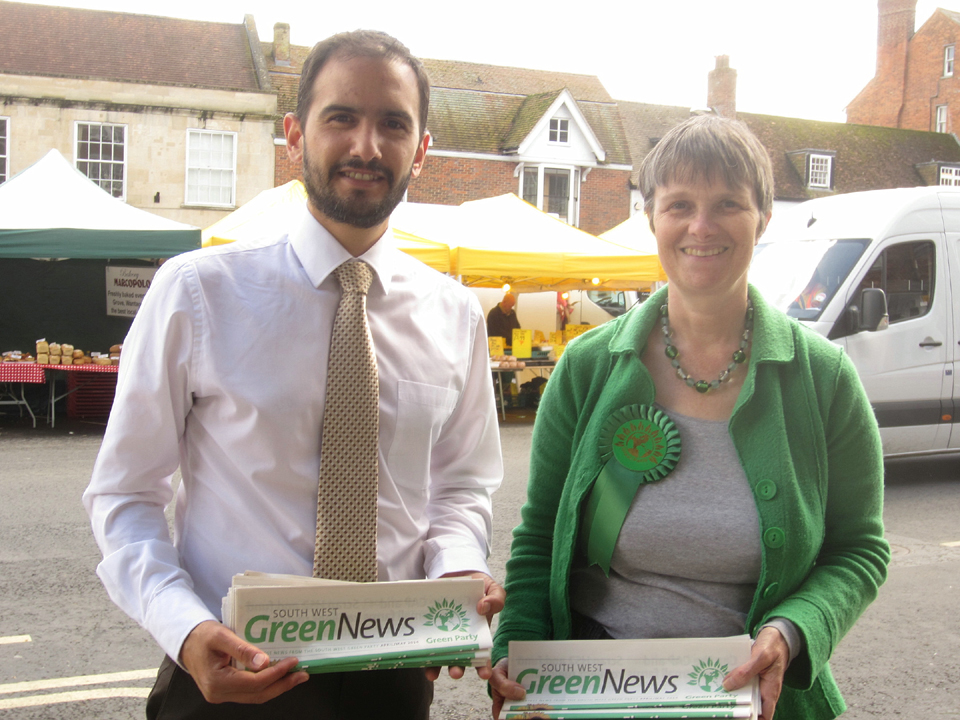
 The Green Party hit High Street, Marlborough, yesterday (Wednesday), the first and possibly only political party to set up a stall seeking support for their candidates standing in the six South West seats in this month’s EU elections.
Green economist and author Molly Scott-Cato, their leading contender, who is a local councillor in Stroud, Gloucestershire, was there with another candidate, Audaye Elesedy, canvassing electors.
And despite the impact the Greens have had in Europe – they are the fourth largest political group with 58 MEPs – they discovered that it was UKIP that was uppermost on voters minds.
“We have been picking up a lot of disillusionment with the Westminster political parties, which we expected, but a lot of people are responding to that by choosing UKIP, which I think is a big mistake,” Molly told Marlborough News Online.
“Yet they don’t have a clue as to what UKIP’s policies are because UKIP don’t have a manifesto. They deliberately burned it. And if you work in politics you know that UKIP really isn’t a force. The people they are electing are headless politicians.”
She believes support for UKIP is media driven with the Greens given virtually no air pace and that voters who have lost faith in politics – and with good reason – need to raise their horizons and study the Green manifesto.
The Greens have, for example, successfully campaigned to cap bankers’ bonuses, tighten air pollution laws and ban bee-killing pesticides, as well as seeking green jobs for young people, charges for plastic bags and the reform of the Common Agricultural Policy in favour of small farmers.
And the Greens are in the forefront of the fight to ban fracking for underground shale gas, in line with efforts to reduce EU-wide greenhouse gas emissions to prevent global temperatures rising.
“The Greens are different,” she insisted. “We look different. We have many women in high-profile positions and lots of young people who are inspired by our vision for their future.
“And we sound different. We don’t shout or abuse people who disagree with us. We tell the facts as they are and recommend solutions. Studies show Greens are some of the hardest working MEPs in the European Parliament.
“I am a green economist because I believe that most of our environmental problems arise from the way our economy is organised. A capitalist economy is accumulative and relies on inequality to generate innovation. Hence it results in injustice and unsustainability.
“We have to constrain markets so that they work for the common good.”
She pointed out too: “The Euro was always a misguided project and the Greens have always opposed it. The single interest rate means that we have the same price of money in economies with wildly different situations.”
But what is her assessment of the May 22 proportional representation vote, the more so as the Greens have jumped ahead of the Lib-Dems in the polls?
“It’s looking really on the edge,” said Molly. “We’ve got to build on the momentum we have, get two or three points ahead of the Lib-Dems and on that basis we could just win one seat if we can get out people out to vote.”
She nevertheless believes that UKIP will take two, possibly three of the seats, the Tories one and Labour one.
“It’s going to be a very tight fight for the last two of the six seats,” she declared. “So I haven’t bought my ticket to Brussels yet.”
 Wiltshire to contract out youth services to area boards – with some support


