







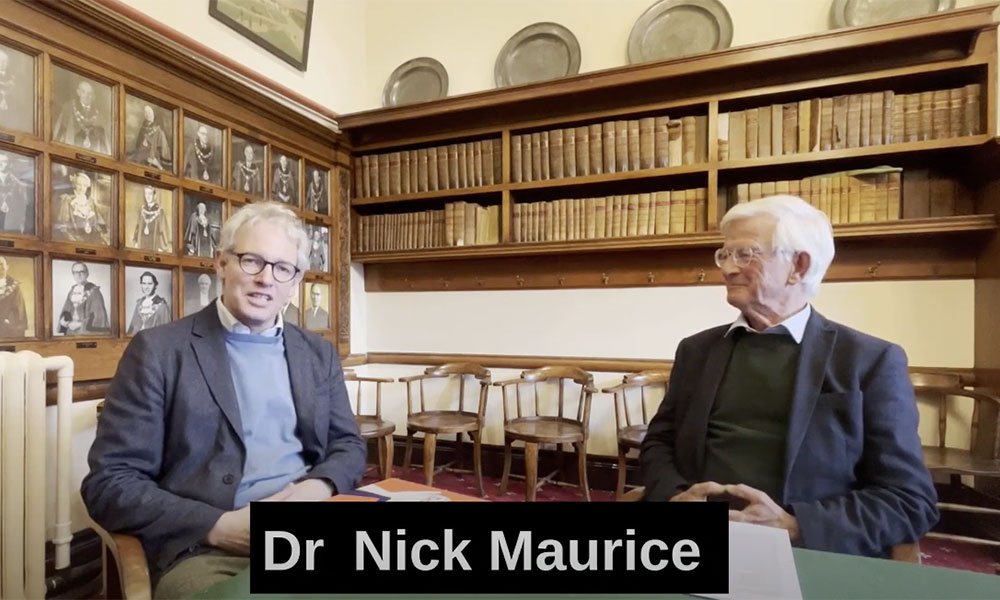
On Friday of last week, 28 April, Devizes Constituency MP Danny Kruger met with Dr Nick Maurice, Dr Barney Rosedale, Dr Nick’s onetime fellow GP in Marlborough and Dr Rosedale’s wife Rachel Rosedale to discuss the question of the controlled legalisation of drugs – a subject on which Dr Nick has written as a Marlborough.news columnist in the past.
Dr Nick writes: “Danny made it clear that he has a divided opinion on the subject and did not leave the meeting saying that the arguments we had put forward for the legalisation of drugs had influenced him to support this cause…… “I have asked him to share this (below) with members of the All Party Parliamentary ‘Group Controlled Drug Dependence’ of which he is Chair and hope that this might lead to a rational debate in the House of Commons on the subject.”
The article for Danny to share with his All Parliamentary Group:
Is it possible for the Government to have a rational debate on the subject of the controlled legalisation of drugs?
We, most of us, take ‘mood altering substances’ whether alcohol, tobacco, cannabis, cocaine or heroin to name but a few. They are all dangerous and account for disease and death. What is the rationale behind making some legal and others illegal?
Ever since the deaths of four of my patients from heroin use during my time as a GP in Marlborough – young people branded as criminals for the use of the drugs let alone the petty crime they were all involved in to ‘feed their habit’ – I have been convinced that by bringing all drug use into the public health arena rather than the criminal justice system, we would have a major impact on mortality and morbidity rates and of course on crime rates, including knife crime, and our prison population.
I have no doubt that my four patients would be alive today, having received the help they deserved within the NHS, if it were not for the fact that what they were doing was illegal.
Following their deaths in 1986 I helped, thanks to support from Lord Joel Joffe, one time defence lawyer to Nelson Mandela at the Rivonia trial, but by this time Chair of the Swindon Health Authority, to set up, and subsequently to become, Chair of Druglink (a drugs advisory service) based in Swindon which provided advice to drug users. But more specifically we were the first drugs organisation in the country to provide clean needles and syringes to heroin users to prevent the spread of HIV infection which was taking off in this country at the time.
Let’s consider some facts:
- In 2021 there were 9,580 alcohol related deaths and approximately 78,000 smoking related deaths in the UK.
- In 2021 there were 1,213 deaths from heroin and morphine related substances
- In the UK only 8.6 per cent of adults between the ages of 16 – 65 use illicit drugs whilst over 80 per cent use alcohol.
- As far as prison populations are concerned 14 per cent of men and 15 per cent of women are in prison for drug related offences. In 2022 10,775 people were in prison for drug related offences.
- It is clear that there is a strong relationship between knife crime and illegal drugs although I couldn’t find clear statistics other than that in 2021 there were 46,239 reports of knife crime incidents.
- Re-conviction rates are more than double for prisoners who reported using drugs in the four weeks before custody compared with prisoners who had never used drugs (62 per cent versus 30 per cent).
- In 2020/2921 there were 31,931 incidents in which drugs were found in prisons in England and Wales
- 19 per cent of people reporting heroin use, said they had been introduced to and used heroin for the first time while in prison.
- In 2021/2022 it cost £48,162 per year to keep a prisoner in jail at the taxpayers’ expense.
- It is estimated that the war on drugs costs the UK taxpayer £400 per annum, The money could be spent on the quality control of drugs, education around the use of drugs, treatment of drug users and child protection. i.e. revenues could be diverted from criminal gangs to Government coffers.
- It is worth pointing out that it is known that a number of MPs are taking drugs. It was reported by ex MP Mark Oaten that the taking of drugs in Parliament is commonplace. He stated “I used to know MPs who were snorting cocaine off their office desks”.
- Let’s remember that opium-based drugs e.g heroin, morphine and methadone, while illegal, are being used by the medical profession for the relief of pain.
- In 2021/2022 Tax duty on the sale of tobacco was £10.29 billion and for alcohol was £12.7 billion
In 1974 an estimated 50 per cent of men (including myself!) and 40 per cent of women smoked. Now those figures have dropped to approximately 20 per cent for both men and women, precisely because of the public health measures that have been introduced.
Us older generation remember the days when during parties, popping into the pub for a pint or even travelling by bus, train or air one would be surrounded by smoke and smokers. And yet that is a thing of the past precisely because of laws introduced as public health measures rather than the habit itself being outlawed.
There is a global change of attitude and decriminalisation has already taken place in many countries in the world. In the UK we are getting left behind.
The countries / states in which drugs are legal Antigua + Barbuda Argentina Armenia Australian States: South Australia, Australian Capital Territory, Northern Australia Belize Bolivia Chile Colombia Costa Rica Croatia Czech Republic Estonia Germany Italy Jamaica Mexico Netherlands Paraguay Peru Poland Portugal South Africa Spain Switzerland
United States of America: Alaska, California, Colorado, Connecticut, Delaware, Hawaii, Illinois, Maine, Maryland, Massachusetts, Nervada, New Hampshire, New Mexico, New York, Oregon, Rhode Island, Vermont, Washington D.C. Uruguay Virgin Islands (US Territory)
In Portugal where drug use was decriminalised in 2001, the findings have been that there has been:
- an increased use of cannabis.
- decreased use of heroin.
- increased uptake of treatment for drug related problems.
- a reduction in drug related deaths.
In Portugal decriminalization has enabled earlier intervention and more targeted therapeutic responses to drug users and also increased collaboration across a network of services and the increased attention to adopting policies that work. This is perceived to be reducing the level of current and future drug use and harm.
To what extent is our attitude to drug users in the UK fuelled by the current illegality of what they are doing – “They’re all b.…y criminals and scroungers!”? And how far is it obstructing a proper pragmatic and human approach to their problems?
What will it take to persuade the Murdoch press and thus our politicians that decriminalisation of all drug use is the course we should take here in the UK and that by doing so we shall dramatically reduce the prison population and its cost at tax payers’ expense, and, with the provision of proper care for those with drug problems, reduce mortality and morbidity rates particularly among the young?
And think of the impact on criminal gangs that will be put out of business, and on the need for ‘stop and search’ which has such an awful reputation particularly amongst BAME communities, and those young people persuaded by gangs to act as ‘drug lines’ to rural communities…. etc.!
Surely the rational approach is to accept that we all, at least most of us, take mood altering drugs in one form or another and that by bringing them all into the public health arena rather than the criminal justice system, and making these drugs legally available, but in a controlled way, we shall be making our country a considerably safer and healthier place in which to live and work.
This summary on need to change current drugs policy focusses on the UK. But we must also have in mind the colossal damage done by leaving trade in drugs in the hands of criminals across the globe. Poorer communities and indeed entire countries of Central and South America, the Caribbean, West Africa and South Asia suffer hundreds of thousands of deaths a year from violence either caused by drug wars or fuelled by drugs money.
The Guardian and the Times have declared that they support the legalisation of drugs. As reported “The Times has boldly gone where few newspapers – and very, very few politicians – have ever dared to go before by declaring itself in favour of legalising drugs in Britain.
In a leading article, “Breaking Good”, the paper has supported a call on the government by the Royal Society for Public Health (RSPH) to decriminalise both the possession and use of all illegal drugs. Accepting that it “is radical advice”, the Times thought it “sound” and urged ministers to “give it serious consideration”.
It is worth pointing out that the controlled legalisation of drugs in the UK is supported by the Royal College of Physicians, the British Medical Association, the Faculty of Public Health and the Royal Society of Public Health. And the National Police Chiefs’ Council in England
 April Weather review – cool, cloudy and wet