







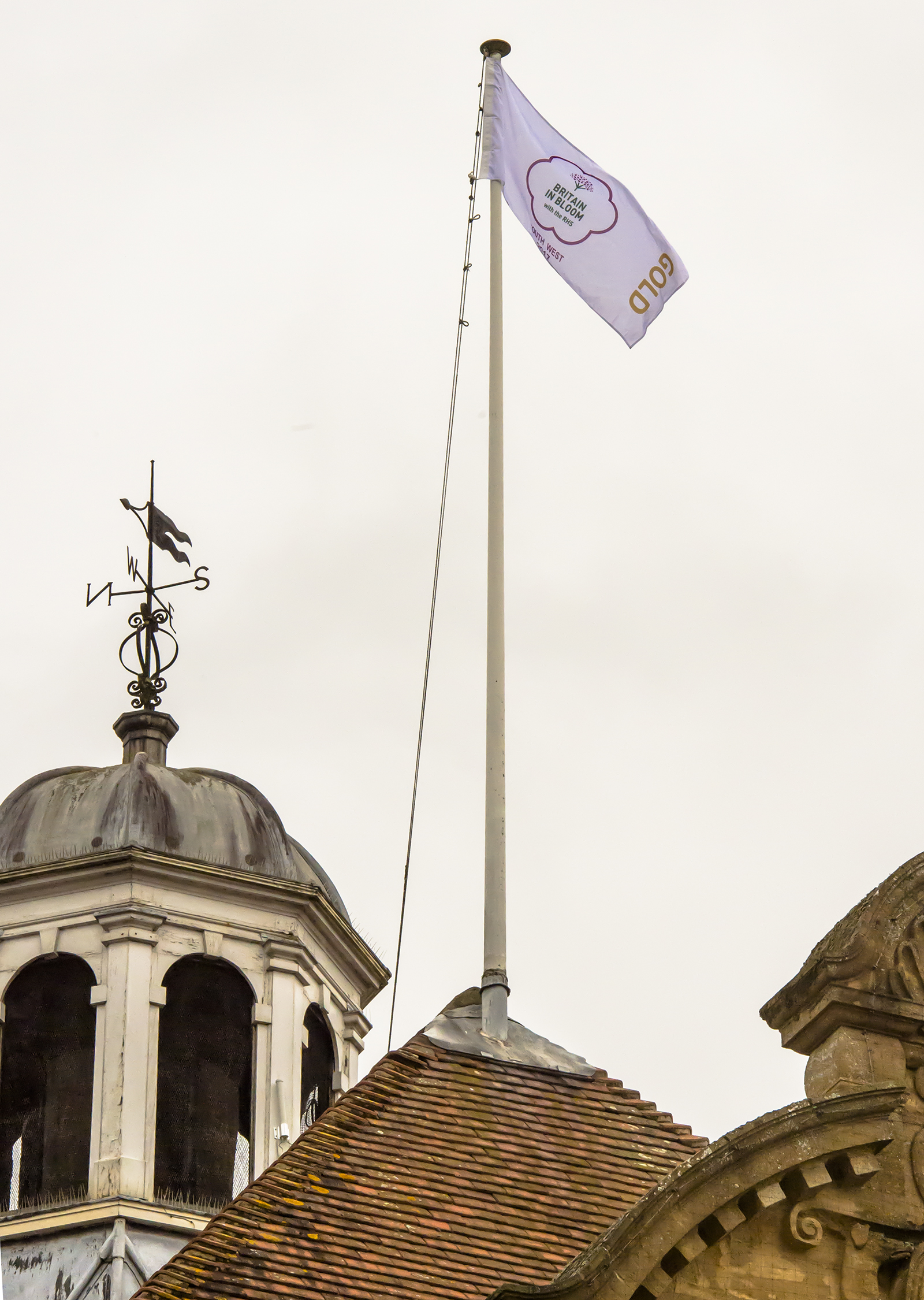
The Gold award to Marlborough in Bloom and the Best Kept Village Award to Minal within a few days of each other are a great tribute to all the work behind the scenes and the different people involved in it.
The Celebratory Flag on the Town Hall and the Plaque beside the Village Hall in Minal speak not just of the achievement being celebrated but also of proper pride in a place.
 These images of stability contrast vividly with so many other images in the news, but none more so than the sight of hundreds of thousands of Rohingya Muslims fleeing across a border into Bangladesh. Strange though it may seem, the two can inform and illuminate each other – pride in your town or village and the chaos of those who have no home.
Refugees have always had an important place in the consciousness of both the Jewish and Christian faith because they are people not just without a home, they are people without a homeland. Land, the Promised Land, is at the heart of the Old Testament and an assumed presence throughout the New. When we see someone forced to leave their country, who is stateless, we see someone who has been deprived of an essential part of what it is to be human.
Boundaries, or more specifically Borders, are often seen as delimiting and negative, but they needn’t be.
Humans are unavoidably limited and restricted creatures, so our knowledge and understanding of the world is framed by our horizons – or boundaries. The world can only be known from a particular vantage point and this is the starting point from which we discover who we are and from where we learn morality. The result can be community cohesion and a confidence to engage openly with those who are beyond our borders and who are different from us.
The hazard, of course, is that the boundaries become not a basis for exploration but a means of exclusion; a stepping stone towards ethnic cleansing. Hence the wish of many to dismantle borders.
As has been suggested, Borders are a necessary part of human belonging, so the need is not to dismantle borders but rather ‘reconfigure them so that both ‘inside’ and ‘outside’ relationships are enabled in morally positive ways’.
Andrew Rumsey, author of Parish: An Anglican Theology of Place, goes on to say
This requires starting not a community’s limits but at its centre, for boundaries are merely the extension of our core vision and purpose. If a society’s borders have gone haywire, we can be sure something is badly wrong at the centre.
 As we look around Europe and the wider world today, it is hard not to agree with this observation.
To return to the centre is, I suggest, to return to the local and the specific. The local pride that results in a Best Kept Village or a Celebratory Flag for a Town in Bloom is a good starting point from which to embrace the world rather than retreat from it. It can allow us to delight in what is different rather than feel threatened by it.
 REVIEW: Kontakt and clay – Julia Schuster exhibition at the Mount House Gallery, Marlborough College


