





 As the coalition government’s restructured NHS comes closer to its 1 April 2013 D-Day, NHS risk registers are splashed with columns of red – red for risky times ahead as new organisations take over. The latest risk to alarm Wiltshire’s Primary Care Trust (PCT) and the new Clinical Commissioning Group (CCG) is the NHS 111 freephone service for 24/7 urgent care advice.
Wilthsire’s service – replacing NHS Direct – will be provided by Harmoni HS Ltd which has won eleven other 111 contracts across England. Harmoni styles itself as ‘the largest independent provider of urgent care in England’ and earlier this month it was bought by Care UK for a reported £48 million.
 Asked by Marlborough News Online about the Care UK takeover, NHS Wiltshire says that over the next year Harmoni’s operations will be integrated with Care UK, but “local operational services and delivery will not be affected by these changes in structure.”
The Wiltshire contract with Harmoni is for five years from 2013 with variation and change of control provisions. And if Harmoni do not pass ‘strong performance monitoring’ and meet ‘agreed key performance indicators’, a quarter of the money due to Harmoni for Wiltshire’s 111 service will be at risk.
NHS Wiltshire do not intend to undertake a further risk assessment of the Harmoni contract as it has been assured that the contract ‘will continue to be held by Harmoni HS Ltd.’
But worry as to whether the new contract will be ready for its ‘soft launch’ in February does show very red on the transition risk register drawn up for NHS Wiltshire and the CCG. It is flagged up as a ‘key service implementation’ on a ‘tight timeline’ involving ‘multiple interdependencies’.
Since October 24 the PCT has employed a full-time project manager to ‘bring more resource to the problem’: “However, this project is still high risk with challenging work schedules and deadlines.”
In blunter terms: the local NHS budget has to bear the costs of ensuring a non-NHS contractor can fulfil its contract. This is probably something that will happen more often as NHS services are put out to ‘any qualified provider’, but the CCG remains responsible in law for their efficient and safe running.
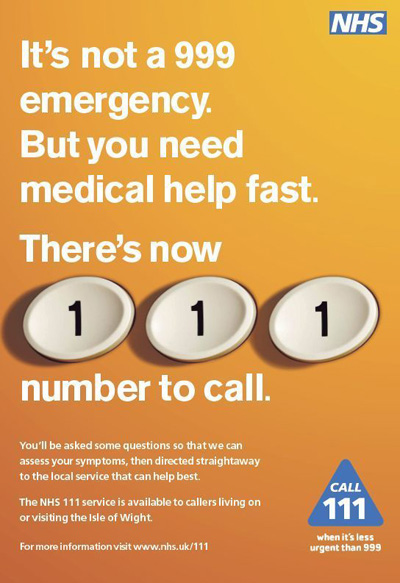 The main area of concern across the 111 contracts is the recruitment and fast training of appropriate staff in the necessary numbers.
And when the contract is fully launched, what are 111’s prospects? The final report by Sheffield University evaluating the early pilot sites found good levels of satisfaction with the new service.
But NHS 111 – one of the coalition’s flagship programmes – was supposed to make savings for the NHS budget. The report found wide variations between the pilots in terms of costs with overruns partly caused by a rise in ambulance call-outs and more visits to accident and emergency centres once the 111 service was in use.
The average increase in costs compared to those for the old services was an additional £307,000 per month. But the pilot sites varied between one contract a saving of £118,000 a month and another with extra costs of £733,000 a month.
Dr Peter Holden, a negotiator for the British Medical Association’s GP committee, told the GP’s journal Pulse that the roll-out of the new 111 service was ‘unproven’: “We are concerned at the speed of the roll-out, which means taking some big risks. The cost savings are mind-blowingly small.”
His committee’s view is that the roll-out should take place ‘over an extended number of months, if not years.’
[In June 2012 Marlborough News Online published a letter that foresaw many of the problems with 111 that are now emerging.]
 Vast crowds gather for the Christmas lights and a taste of the Communities Market


