




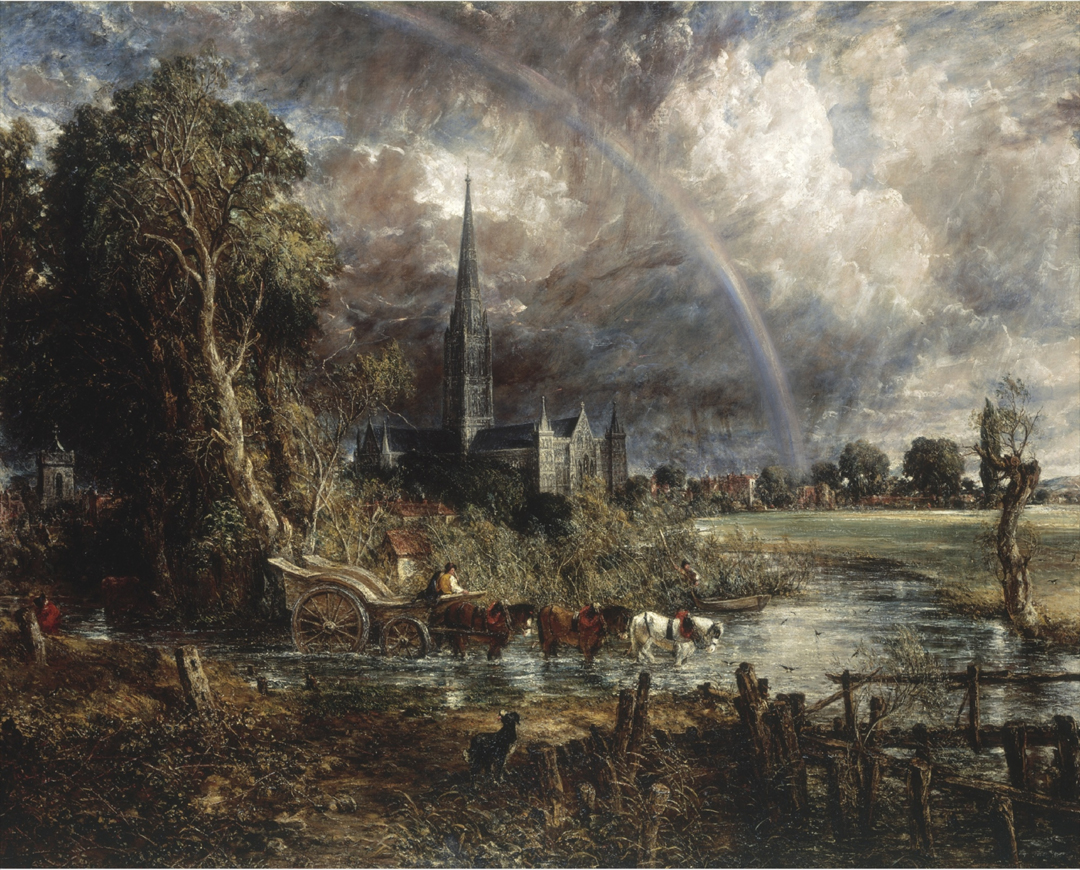
 Salisbury Cathedral, as depicted in all its magnificence by the artist John Constable — with a rare rainbow piercing the clouds — is coming home.
Constable’s masterpiece, Salisbury Cathedral from the Meadows, painted in 1831, the year after his wife, Maria, died in his arms, has been saved for the nation in a ground-breaking partnership deal organised by Tate Britain for £21.3 million.
It will mean that the painting, one of a series of monumental “six-footer” canvases that includes Constable’s The Haywain, will go on display at a variety of venues across the country over the next five years.
And that includes the South Wiltshire Museum, in the Cathedral Close itself, just yards from where it was painted, along with many other Constable works of Salisbury, though not until the year 2016.
“Salisbury Cathedral is one of England’s best loved buildings and Constable’s views of the Cathedral are universally recognised,” the Very Rev June Osborne, Dean of Salisbury, told Marlborough News Online.
“They speak to us of the Christian legacy of this nation and the conviction of so many down the ages that God has both blessed and watched over our land.
“It is marvellous news that this cherished image has been secured as a national treasure and the enjoyment of seeing it will bring enormous pleasure to many people. We very much look forward to welcoming it back to Salisbury in 2016.
“It will be a happy homecoming!”
The Bishop of Salisbury, the Rt Rev Nick Holtam, who includes Constable’s celebrated cathedral landscape in his book ‘The Art of Worship’, added his joyous welcome too.
“I am delighted that this painting by John Constable of Salisbury Cathedral from the Meadows has been saved for the nation and that the South Wiltshire Museum is one of five where it will be displayed,” he said.
“When they visited Salisbury, John Constable and his wife, Maria, stayed in the home of their friend Bishop John Fisher. That is why there are a number of paintings by Constable of the cathedral.
“This painting is perhaps the greatest of them and is one of the nation’s favourite paintings.
“In it the cathedral’s spire rises with soaring hope above dark storm clouds and the rainbow over the cathedral speaks of God’s covenant with all the earth. It still speaks strongly of the purpose and hope of our cathedral.
“I very much look forward to the painting being displayed here in The Cathedral Close when it comes to the South Wiltshire Museum in 2016.”
The painting owes its commission to Bishop John Fisher’s nephew, the Archdeacon John Fisher, who was Constable’s greatest friend and confidant, especially after Constable’s wife died at their Hampstead home from TB.
Forever depressingly self-critical, partly because of a lack of recognition of his genius, Constable turned to the church for solace.
His spectacular work, completed in Constable’s studio in Charlotte Street, Fitzrovia, also serves as a metaphor for the pressure the Church of England came under from the rise of Catholicism at the time, the rainbow a sign of hope for the future.
Constable himself, often subject to bouts of depression, was impressed by the cathedral work, declaring: “I am told I got it to look better than anything I have yet done.”
In a letter to his engraver friend David Lucas, on March 23, 1831, before the picture has been sent to the Royal Academy’s annual Summer Show, Constable wrote: “I have made a great impression to my large canvas.
“Beechey was here yesterday, and said, ‘Why damn it Constable, what a damn fine picture you are making, but you look damn ill – and you have got a damn bad cold.’
“So you have evidence on oath of my being about a fine picture & that I am looking ill.”
Artist William Beechey’s admiration was followed by that of Constable’s 10-year-old son Charles, who wrote to his sister Minna: “Papa is painting a beautiful picture of Salisbury Cathedral.”
The painting was hung at the Royal Academy near to Turner’s even bigger exhibit, Caligula’s Palace and Bridge. And yet once again his work received a mixed reception in the press, the colouring of the sky and particularly Constable’s scattered touches of white, the freshness he so prized, were condemned.
“A very vigorous and masterly landscape, which somebody has spoiled since it was painted, by putting in such clouds as no human being ever saw, and by spotting the foreground all over with whitewash,” wrote the critic from The Times.
“It is quite impossible that this offence can have been committed with the consent of the artist.”
Not quite the comment made now by Sir Nicholas Serota, director of the Tate, who was brought up in Hampstead and went to Christchurch Primary School, round the corner from Constable’s old home on the edge of Hampstead Heath.
“Salisbury Cathedral from the Meadows is one of the great masterpieces of British art,” declared Sir Nicholas. “I am extremely grateful to the owners who have worked with us while we have raised the funds to ensure the painting remains in the UK.”
The only shame that remains is that Constable had to wait until nine years before his death in 1837, aged 60, to become a Royal Academician, though never to know he was a national treasure.
He now lies buried in a family tomb in the churchyard at St John at Hampstead.
 Risks are very red for Wiltshire’s new clinical commissioning GPs


