







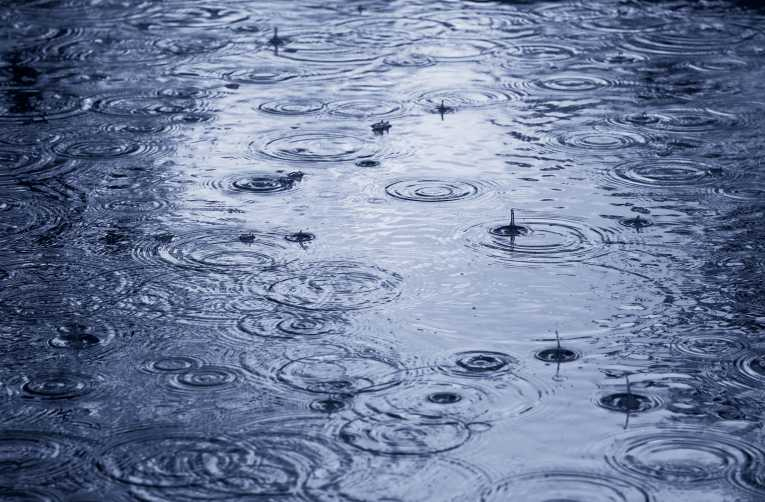
 January was the wettest it has ever been since records began in 1910, reported the Met Office. And so it proved true too in Marlborough, where Eric Gilbert’s weather station has been in operation since 1984.
The deluge in fact produced an estimated 149 million gallons of rain – or approaching 1,000 tons in 31 days.
 “January 2014 proved to be a winter month the likes of which we have not seen before,” Eric (pictured) told Marlborough News Online today (Saturday).
“Rain fell on 26 days in the month producing a record 219.1 mm (8.6 inches), which is 250 per cent of the long-term average making this the wettest January on record.
“This huge total also broke the record for the wettest month, which was previously held by November 2002, when 203.5mm was recorded.”
The very wet January is in direct contrast with January,1997 when just 9.4mm of precipitation was recorded compared with the 30-year average of 87.5mm, January 5 being the wettest day with total rainfall of 24.2mm.
There were three days when around 25mm fell — an inch of rainfall — and five other days when rainfall totals moved into into double figures.
Small hail, less than 5mm in diameter, fell on four days, fog was noted on five days and thunder was heard during two days.
“The rainfall at my site is measured in a Meteorological Office standard 5-inch copper rain gauge for accuracy to 0.1mm,” Eric pointed out. “Although a mild month, January was not a record there being nine warmer Januarys in the past.
“With a mean temperature of 5.1°C it was 1.1°C above the long-term average. The record for the warmest January was set in 2007 with a mean of 6.5°C and in contrast the coldest January was way back in 1987 with a negative mean of minus 0.15°C.
 “The coldest day was January 30 when we had persistent mist and fog and a maximum of just 2.4°C. The continuous low cloud gave us a gloomy day with no measurable sunlight and virtually no solar activity.”
And he added: “ Another memorable feature of January was the frequent strong winds. There was only one day when the maximum wind gust was in single figures, but 15 days with maximum gusts exceeding 20mph. However, there were maximum gusts of 46mph and 45mph on January 25 and the first of the month respectively.”
The diurnal day temperatures showed an increase in the range during January over the past 30 years with the trend increasing from about 11°C in the 1980’s to over 12°C in recent years.
“All the mild, wet and windy weather has been brought about by a succession of depressions and their associated weather fronts crossing the Atlantic before reaching our shores, often moved rapidly along by very strong jet streams, he explained.
“Using the rule of thumb that one-inch of rainfall is equal to approximately 17.4 million gallons per square mile, I calculate that the Marlborough area has received something like 149 million gallons of precipitation, or approaching 1,000 tons, in 31 days.”
 Exceptional rainfall is highlighting the problem of Marlborough’s inadequate sewer system

