




 It has a reputation across the world – and, it claims, beyond – as a magnet for UFO spotters and crop circle hunters. Now visitors to The Barge Inn at Honeystreet will be able to watch the skies from the UK’s first pub observatory.
Wiltshire Council planners gave the go-ahead for the unusual facility to be built last week, when they also green-lit plans for a WC and shower block to cater for the pub’s summertime campers, who pitch their tents in a field behind the pub.
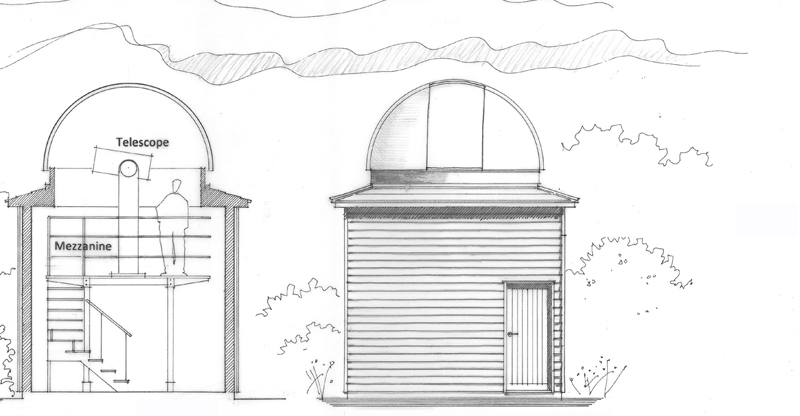
But the applicants say the 15ft-tall domed construction – which will be one of only three publicly-accessible observatories in Wiltshire – will help boost generally slow winter trade at the remote 205-year-old canal-side pub, which relies on a healthy summer tourist trade for its survival.
The observatory will be fitted with a professional-standard telescope, and would enable users of the pub and the campsite, as well as other interested groups, to view the night skies. Images will also be relayed onto screens within the pub.
In his application to Wiltshire Council, Ian McIvor of Honeystreet Ales – owner of the pub and brewer of Area 51 cider, Roswell ale, and Alien Abduction green beer – said: “Although there is great public interest in stargazing and understanding our place in the Universe, there are very few purpose built observatories available to fulfil people’s natural curiosity.
“Building and operating a research quality observatory is both financially demanding and technically challenging. As a result, the number of observatories available for public and educational use is very limited; indeed there are only two available in the whole of Wiltshire. “Building the Honeystreet Observatory in the grounds of the Barge Inn is an exciting and innovative project that would help attract visitors from across the county and even further afield.
“The Barge is a very seasonal pub and in the winter months suffers from its remote location and operates at a loss. “The use of the observatory would be mainly a winter activity, benefiting from the longer hours of darkness. This would help attract customers to the pub during what is a very difficult trading period and help underwrite the pub’s ongoing viability.
“Pubs are open long into the evening and are a logical location for an observatory. Late night summer observing will be assisted by the location being on the Barge Inn campsite and the convenience for visitors being able to stay overnight at low cost.”
 Mr McIvor said the pub’s rural location made it the ideal spot for an observatory.
“According to a Campaign to Protect Rural England survey, only two percent of respondents said they could count more than 30 stars in the night sky. Being in the Vale of Pewsey, The Barge provides a ‘dark sky’ location, away from the light pollution caused by towns and cities. It is therefore an excellent location to site an observatory,” he said.
The proposal is backed by pub users, and by the Wiltshire Astrological Society which, said Mr McIvor, is offering technical assistance and equipment, and is keen to run stargazing talks and presentations.
“Modern technology allows the observatory dome to be remotely controlled and a live feed from space to be shown inside the pub, something totally unique and a world first for Wiltshire,” he added.
Although work has not yet commenced, the facility already has a website – www.honeystreetobservatory.com – featuring plans for the structure, star maps, and a detailed real-time weather report from Mars.
 The fiftieth anniversary of Churchill’s funeral brings many memories for trumpeter Basil King


