






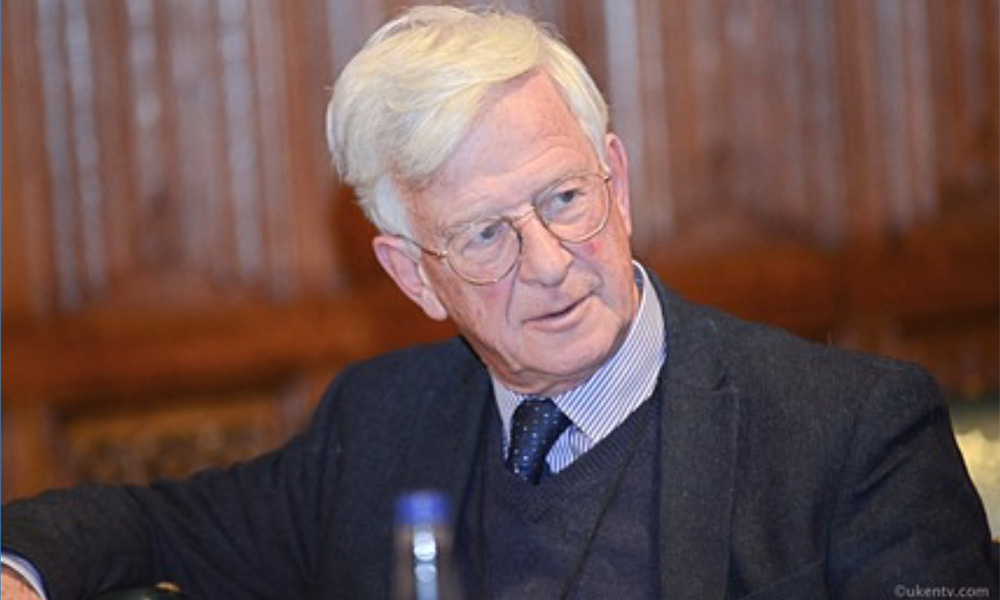
By way of background, I have to declare myself as primarily a Global citizen, despite, or perhaps because of, having been embedded in Marlborough all my life, but having volunteered to work for Voluntary Service Overseas in Togo aged 18 in 1961-2 and as a medical student in Papua New Guinea in 1967-8, then in Nepal with the Britain Nepal Medical Trust in 1973-4 and with Oxfam in Cambodia in 1980.
That same year I helped to set up the partnership between Marlborough and the predominantly Muslim community of Gunjur in The Gambia, a partnership that has seen the exchange of some 1700 young people between the two communities always living in the homes and compounds of their hosts. The last time I lived and worked in Gunjur in July 2019 was my 71st visit.
With that background you won’t be surprised to know that I have always believed in the vital importance of international collaboration for peace, prosperity and justice in the world and am therefore a passionate Remainer and felt a real sense of despair following the result of the 2016 referendum. That despair was not just confined to the Brexit decision but also to the deep divisions that were uncovered within UK society as a result of the referendum – populists versus internationalists.
Let’s consider some facts
- While the 2016 referendum revealed that 48% of the public voted to remain and 52% voted to leave – this might be described as a ‘narrow margin’.
- It is clear that at the time of the referendum nobody knew, and indeed would not know until a) a final agreement was reached, and b) a few years had passed after leaving the EU, what the true implications of leaving would be.
- It is clear that the overwhelming number of people voted with their ‘hearts rather than their heads’ I hold up my hand and admit I was one of them.
- If one were to line up 100 MPs and ask the question, “would it be true to say that as a member of Parliament your prime objective is to do the best you can for the country and your constituents in particular – anyone disagree?” It is unlikely that anyone would contradict that statement. Isn’t it therefore interesting to find that there was considerable division within the Conservative party. Robert Buckland Conservative MP for Swindon is quoted as saying:- “I passionately believe that we should be a member of the EU and have felt that for many, many years and I’ve made no secret of that – but it’s not about me,” he said. I assume he meant that it was about his constituents. While James Gray, Conservative MP for North Wiltshire, described the EU as a “failing organisation”. “I think it’s been a terrible organisation – an economically disastrous organisation, so I’m very glad our nation is going to be independent from it.” At the same time we were being fed lies about clawing back £350 million per week from the EU to fund the NHS.
- It was significant that there appeared to be a racial element to the way in which people voted. The majority of people living in the most ethnically diverse communities e.g. London and greater Manchester were more likely to vote to remain (approximately 60% in both cities), while in the less diverse communities the majority voted to leave the EU, e.g. Cornwall 56% and Cumbria 62% Norfolk 59% – surely a reflection of ‘internationalism versus populism’.
- It has taken four years to reach an agreement between the 27 states in the European Union and the UK Government.
- It will be several years before we fully understand the practical, economic and social implications for the general population of the UK, of leaving the EU under this agreement. But already we are aware of the impact on businesses and indeed we read that some hundreds of small UK businesses are considering transferring their headquarters to Europe to avoid the appalling bureaucracy involved in exporting to Europe from the UK.
- Recent research by the British Foreign Policy Group found that, and I quote, ‘the heart of the nation favours a relatively open and ambitious international agenda working alongside a variety of friends and partners. More people would like a closer post-Brexit relationship with the EU than the deal negotiated by Boris Johnson provides, when compared with those who approve of his agreement with the EU’.
- Is there not a considerable irony in the fact that Boris Johnson wants to maintain the United Kingdom and is vehemently opposed to calls for Scottish and now Welsh independence while at the same time divorcing the UK from the EU.
Proposal
- It is highly probable that there have been and will continue to be negative repercussions for many businesses and individuals. But in all circumstances and assuming the EU membership is prepared to consider this, would it not be appropriate at the time of the next general election for an assessment of the impact of Brexit be undertaken and political parties to agree that a second referendum be carried out once we understand that impact?
- In order to gain that knowledge and fully understand the detailed impact in all its manifestations of leaving the EU, an in-depth, fully independent impact study should be carried out, starting immediately and continuing until close to the time of the second referendum and a report produced, on the basis of which the public will be able to recast their votes objectively rather than emotionally. I stress the word independent and ideally I would hope that the main political parties would reach agreement on a) such a study should be undertaken and b) who would make up that independent body to ensure that there was no political or idealistic bias in the report. Of course, it goes without saying that such a report will have to carefully differentiate between the impact of Brexit as opposed to that of the pandemic.
Additional point
Given the result of the 2016 referendum, whereby those who voted ‘leave’ felt we would be better off not belonging to the European Union, does this not raise the question of the negative role that our Members of the European Parliament must have played for us to reach the point where we felt we must leave?
Where did MEPs go wrong in not adequately representing the requirements of the UK and why are we in the UK dissatisfied with our membership whilst the other 26 states are satisfied? Should not our MEPs Nigel Farage et al be held to account?
FINALLY In the context of this debate I would encourage our politicians to always remember James Freeman Clarke’s quotation “A Politician is someone who thinks about the next election while a Statesman is someone who is concerned about the next generation”
I rest my case.
 Marlborough LitFest announces full programme