



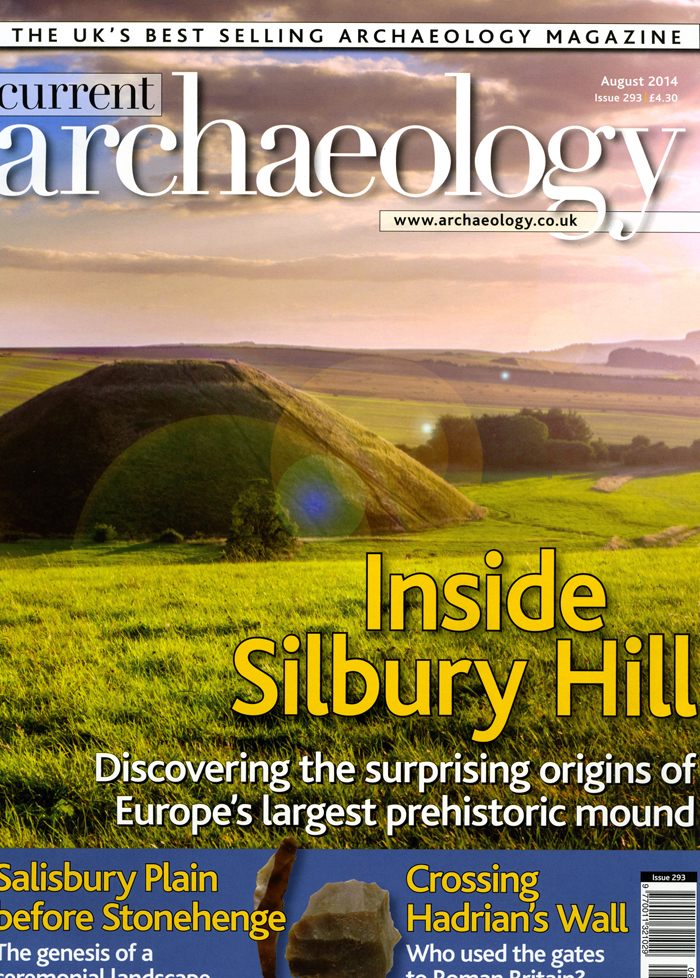
 Here’s something to ponder on as you lie on the beach or wait for the barbecue to heat up – or the rain to stop: did our ancestors believe the River Kennet was the head waters of the sacred River Thames?
Dr Jim Leary who led the most recent exploration of Silbury Hill and proved the Marlborough ‘Castle’ Mound was in fact Silbury’s ‘little sister’, has given the idea some new currency and weight.
In a lengthy article about Silbury Hill in the August issue of the magazine ‘Current Archaeology’, Jim Leary notes that Silbury, Avebury and West Kennet long barrow are “at the head of the River Kennet, which flows directly into the Thames”:
“Today, we say the Thames flows up through Oxford, but that’s the result of modern cartography making the longest tributary the head of the river.”
“I think Neolithic people could easily have seen the River Kennet and the River Thames as one and the same. The largest henge in the country, at Marden, lies at the head of the River Avon, so – if Silbury was considered the head of the Thames – we are looking at a focus on the sources of major sacred rivers.”
This is a very challenging notion. It forms part of the centuries’ old search for an explanation of the location of ancient monuments as well as their purpose. They are, after all, monuments for which we have no contemporary written accounts, let alone written clues.
We have to imagine a world without even a school atlas, without the tape measure or the theodolite and certainly without aerial photography.
 When, long, long ago, you were walking towards the setting sun on the southern bank of the great River Thames, at its junction with the Kennet (as modern maps name it) you would surely not attempt to cross it to continue along another, then nameless, branch of the two merging rivers – which we now call the Thames.
You would simply fork left and follow the southern bank of what we now call the River Kennet. And when you reached the point at which this river, which you thought was still the Thames, rose from the earth, you might well build something significant to mark the river’s birth.
The problem is that we are unlikely ever to know. Unless archaeologists come up with some truly amazing piece of evidence, it will remain a mystery. And Dr Leary’s theory will waft about among the universities and experts, and may one day come to be called ‘accepted wisdom’…or it may remain a hypothesis.
The official record of the recent exploration of Silbury (see Marlborough News Online’s earlier article), provides, Dr Leary, says “this generation’s statement about Silbury Hill”: “But every generation creates the hill that they want. In that sense, it is still serving its purpose to this day.”
Much the same can be said about the theories on most of the why’s and wherefore’s of Neolithic times.
 Cricket: Devizes hold on for narrow victory in rain-shortened match


