





Marlborough Tourism
Britain’s widest high street
 For over eight hundred years, people have been coming to Marlborough to shop. King John granted the town its charter in 1204 and the twice-weekly market survives to this day. In the 17th century Marlborough High Street was described as having “on both sides many goodly shops well filled with rich and costly commodities, silks and tafety, cloath, and lace, linnen and woolen, gold and silver. No braver wares can be had or bought in London.” Those who visit Britain’s widest high street might argue that not much has changed today. And while Marlborough’s traders continue to offer customers the very best of whatever it is they sell – there’s plenty to do and so outside of our fine retail establishments.
St Peter’s Church
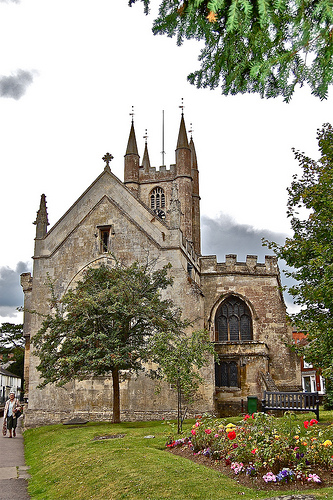 Marlborough High Street is flanked at each end by a church. And every Saturday, the church of St Peter’s at the western (Devizes) end of High Street opens its tower to tourists – for those happy to climb the 138 steps to reach the top. The tower affords pretty much unparalleled views over Marlborough town centre, but also reveals one of its best-kept secrets – Britain’s widest high street is kinky. From ground level you wouldn’t know it, but from the tower you can see that High Street has a definite curve. The reason? High Street was laid out by Norman town planners, back in the days when the town had a castle. To the south of High Street curves the River Kennet, which was prone to seasonal floods. The high street is laid out at the point nearest the river which is not on the flood plane – hence the curve. There’s been a church on this spot since 1100, although the present St Peter’s was rebuilt in 1460. It is best known as the place where Cardinal Thomas Wolsey – one of the most powerful men in the land under Henry VIII – was ordained. In 1974 the church was declared redundant and a few years later Wiltshire Council proposed a super new roundabout for the town, which would have required the demolition of the building. From the public outcry the St Peter’s Church Trust was born, and thanks to their efforts the historic church still stands – although we never got our roundabout, which we’re sure would have been equally impressive.
Marlborough College
At the far west of the town is Marlborough College, one of Britain’s leading public schools (which, for our American visitors, means a private school – confusing, we know). It was founded in 1843 for the sons of clergymen, in premises formerly known as the Castle Inn, which – like many coaching houses in the town – found itself on its uppers when the Bristol-to-London railway line was opened, negating the three day horse-drawn slog from the Capital to the west country along the A4. Notable former students include the architect William Morris, Lady in Red singer Chris de Burgh, Guinness Book of Records editor Norris McWhirter, travel writer Bruce Chatwin, war poet Siegfried Sassoon, the poet laureate John Betjeman, and a fair few royals, including Mark Phillips, Princess Eugenie and Kate Middleton.
Merlin’s Mount / The Mound
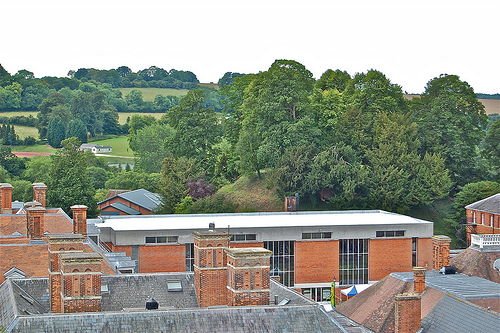
Within the grounds of the school is (depending on your preference) The Mount, The Mound, or Merlin’s Mount – until recently thought to have been the 62ft bailey on which the Norman castle was built, but recently – thanks to carbon dating – revealed to be around the same age as nearby Silbury Hill, the largest man-made prehistoric hill in Europe. The Mount is also supposed, by some, to have given Marlborough its name. The town is described in the Domesday book as Merleberg, which is reckoned to derive from ‘the barrow of Merlin’. Legend would have it that the bones of King Arthur’s court wizard were buried here, and who are we to argue with the town’s motto Ubi Nunc Sapientis Ossa Merlini – where now are the bones of wise Merlin. And unless you are a pupil at the school there’s really only one way to see The Mount – from the top of the tower at St Peter’s Church.
You can read Tony Millet’s excellent piece on The Mount UPDATE At the other end of High Street are St Mary’s Church, the Town Hall and The Green.
 St Mary’s Church
 St Mary’s Church
There have been churches on the site of the present St Mary’s since Saxon times, when The Green was a Saxon village. A Norman church was built in around 1160, and a few pieces remain, including an arch. It took the name St Mary’s in 1223. When Marlborough was under a Royalist siege in 1642 the Parliamentarian commander took refuge in the church and the north side of the tower still bears the marks of shot from Royalist guns. The church was rebuilt by the Puritans after the Great Fire of Marlborough destroyed most of the town in 1653.
Among the interesting artefacts at the church is a statue of the Roman goddess Fortuna, thought to have originated from Roman Cunetio – now the nearby village of Mildenhall. It was built into the west wall of the nave during the 17th century rebuilding.
Marlborough Town Hall
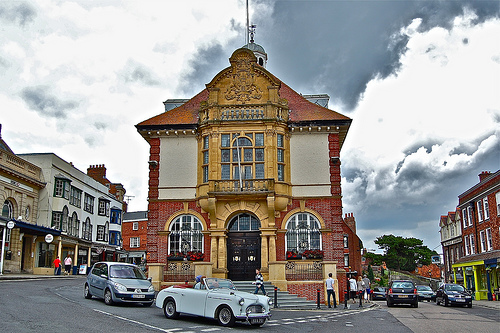 Virtually next door to St Mary’s Church is Marlborough Town Hall, the civic centre of the town and venue for events throughout the year.
Built in 1902, the town hall underwent considerable refurbishment in 2004 and is currently undergoing more improvements, which have seen improved access for wheelchair users and buggy-pushers incorporated on the front of the building.
Those with wheels will soon be able to reach the first floor Assembly Room if plans reach fruition – with a Great Glass Elevator scaling the exterior of the Grade II listed building.
The town hall houses a number of Marlborough’s treasures, including oil paintings in the naïve style by the Victorian artist George Maton.
 The Green
 The Green
Several of Maton’s paintings feature the oldest (discounting The Mount) part of the town – The Green. The site of a Saxon village, this part of Marlborough has remained virtually unchanged for 300 years.
Today, visitors to this delightful part of Marlborough will find a blue plaque dedicated to William Golding, author of Lord of the Flies, who grew up in the town, although he never liked the place – it was renamed as Stilbourne and became the setting for his 1967 novel The Pyramid.
Beyond the town – follow to find out more
For more about visiting Marlborough, click here
 St John’s Park reveals stylish new show home


