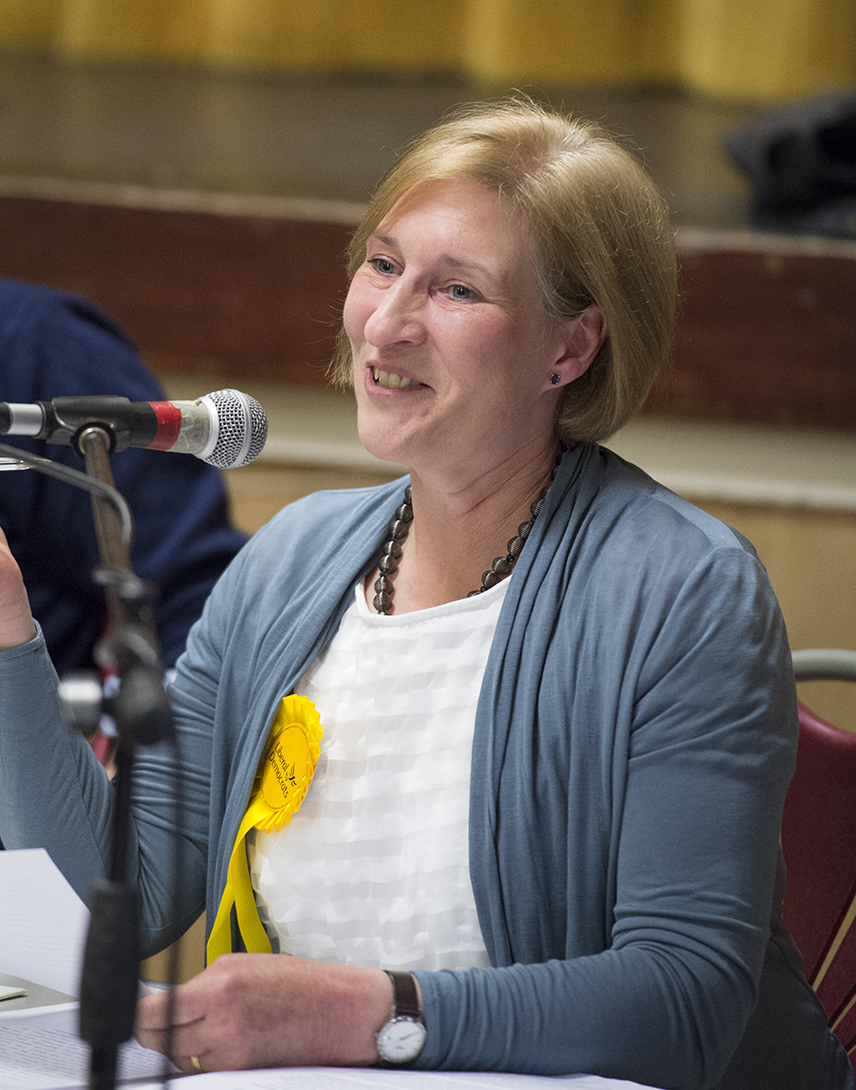






 Pewsey’s Bouverie Hall last night (23 April) staged the Devizes Hustings on the Environment organised by PEAT (Pewsey Environmental Action Team) and chaired by environmental lobbyist and journalist ffinlo Costain.
Of the five candidates standing only three were present. Manda Rigby, who was adopted to stand as the Lib Dem candidate at relatively short notice had a longstanding prior engagement so her agent, Sue Knowles, stood in as a substitute, whereas the Green ‘Elephant in the room’ (or should that read ‘Blue’?) concerned the late decision to pull out by Conservative candidate Claire Perry.
 Chair ffinlo Costain went to great lengths to stress the apolitical nature of the event; relating to a single issue it may be but that did not mean it was there to present a party political position, nor was it set up to be a platform for any of the candidates present. Environmental concerns ran across all points of the political spectrum, reflected by the spread of political colour filling to near capacity the 100 plus seats set out in the hall. Rather than accentuate the divergence of position between the candidates and their parties the evening was marked more by unanimity and agreement on many of the issues raised.
The three candidates who attended were David Pollitt, UKIP, Chris Watts, Labour and Emma Dawnay representing the Green Party.
To correct the imbalance created by the Conservative Candidate’s withdrawal the chair read the key points of Claire Perry’s press release relating to the environmental issues in place of what would have been her opening address.
 Questions raised covered a wide range of issues. From the first by Roger Dobson who asked the panel’s views on Nuclear Power – in order to meet the base load power demand, how can we ensure that we have power to meet a balanced supply without Nuclear?
This was one of the obvious areas for divergence and wide-ranging debate – David Pollitt, who’s own personal experience led him to be very much in favour of a nuclear programme, Chris Watts and Sue Knowles both acknowledging that however unpalatable the nuclear option was it needed to be there to fill the gap before renewable sources were sufficiently developed to be able to take over; to Emma Dawnay’s clear rebuttal ‘no, we don’t want nuclear power’. Her belief was that ‘we could fulfil all our energy needs through different renewables’, supported by ‘good battery technology’ to help with spikes in power usage. One radical suggestion she raised was that all electric cars could be plugged in to the national grid and their combined battery capacity used as a ‘massive distributive storage’ to cover the points of peak demand.
Other questions raised covered issues of the decline in the bee population (every panelist was supportive of bees), cycling (all panellists supported cycling whilst being concerned about safety and lack of infrastructure investment).
 Even the issue of the effect of renewable plant on the landscape – wind and solar farms particularly – didn’t raise much fundamental disagreement, the panel were united in the belief that local opinion should prevail and that areas of natural beauty or productive farm land should be avoided.
Carbon tax was one of the few areas of significant disagreement, David Pollitt was unequivocally against, whilst Chris Watts (Labour) and Sue Knowles (Lib Dem) didn’t support the introduction of such a tax while emphasising the need to reduce carbon usage, and Emma Dawnay made clear the Green position of introducing a ‘tradeable’ personal carbon quota – we all receive the equivalent of a carbon usage ‘ration’ which we can use to trade.
Air Quality, a growing issue across the County drew broad agreement from all, with the need for local funding to take steps to enforce whatever legislation could be in place to curb emissions, particularly from diesel cars, as pointed out by David Pollitt.
Fracking was the other issue that created some divergence of opinion. Audience member Matthew Williams asked the panel whether they would each allow fracking to take place under their own homes. David Pollitt didn’t have any concerns and was in favour, albeit with the sanction of local opinion – if other people resident in the area objected then their voice should  prevail. While Emma Dawnay was fundamentally against, neither Chris Watts or Sue Knowles were in support although, as chair ffinlo Costain pointed out, their parties were not quite so ‘anti’.
The evening closed with a question on TTIP (Transatlantic Trade and Investment Partnership) – for some a valuable trade partnership between the USA and Europe, but for others the creeping entry of American political and corporate power into the European theatre via the back door. All panellists were unanimous in their desire for it not to go ahead, although in the case of Labour and Lib Dems the party lines were generally supportive. An important and generally unaired issue that could have major repercussions either way regarding many areas of policy – NHS and general corporate legislation particularly – but what would Claire have thought? Unfortunately last night we didn’t have the chance to find out.