






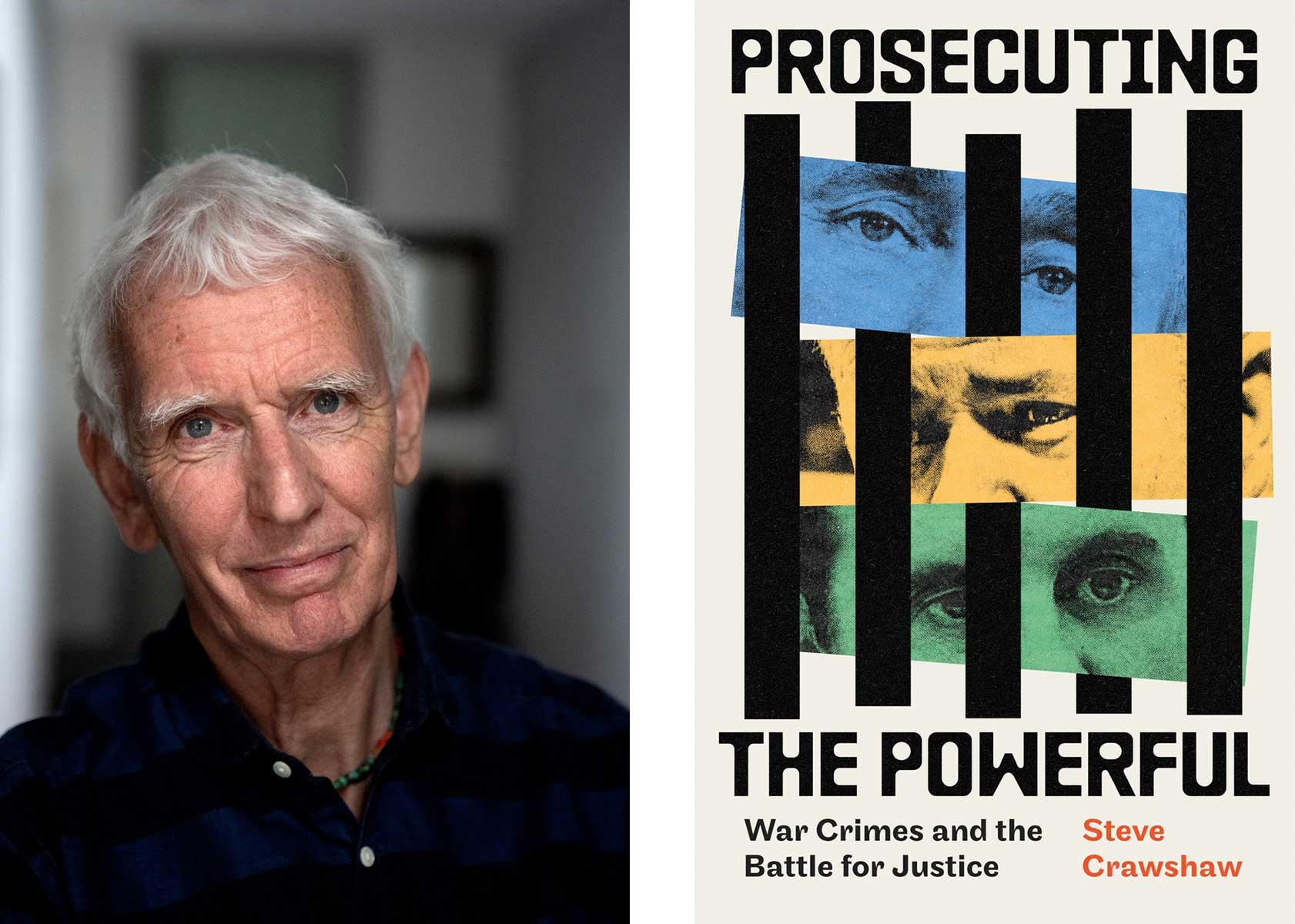
This year’s Marlborough LitFest 2025 is presenting an author whose book casts vital light on the current international news agenda – getting behind its bleakest headlines.
Steve Crawshaw’s Prosecuting the Powerful – War Crimes and the Battle for Justice (published in February 2025) is a must read book for news junkies and for all those who believe our chaotic world urgently needs to find ways to prosecute those powerful leaders who break laws – and so bring justice for those who suffer at their hands.
in the feverish years before and after the collapse of the Soviet Union, Crawshaw was reporting events in Europe for the Independent newspaper – becoming its chief foreign correspondent. This was when war came back to Europe – with the Balkan conflicts, and when Russia was breaking all the rules with its war in Chechnya and beyond.
Then in 2002 Steve Crawshaw changed careers – joining the international non-governmental organisation (NGO) Human Rights Watch as its UK director. He later worked for two more leading international human rights organisations Amnesty International and Freedom from Torture.
With these roles he was on the front line of the developments in international humanitarian and criminal law that heralded a new energy in bringing justice to wars and internal conflicts. Special tribunals set up by the United Nations brought warlords and leaders like Serbian leader Slobodan Milosevic and many of those responsible for the Rwanda genocide (1994) to court – and often to prison.
Then came the formation of the International Criminal Court (ICC) – bringing real hope that the global justice promised by the Nuremberg trials at the end of the Second World War, but which had failed to materialise, would at last take hold.
However, as we have seen in recent months, the reach of the ICC has proved too much for nations who put sovereignty before justice, and believe they have the right to do as they like. National exceptionalism is being allowed to trump justice when it comes to war crimes like those committed by Russian forces in Bucha during the invasion of Ukraine and those still being committed throughout Gaza.
The unique selling point of Steve Crawshaw’s book is how he melds the history of these important developments with his own experiences and reporting. Along the way he relates enlightening stories bringing this complex world of international law to life. As he told marlborough.news: “I find it fascinating to travel to places and meet and listen to the people who are standing up for a better world. In my travels in Ukraine, Israel/Palestine and Syria alike, that has been a real privilege, even amidst the darkness.”
I asked Steve Crawshaw why he decided to write this book: “I guess I had been thinking about the themes for many years – as a journalist covering the Balkan wars thirty years ago, then joining Human Rights Watch just as the work of the ICC got under way. Today, we see so many new possibilities for justice – and so many attempts to suffocate and destroy that work. That tension is central to the book. Things changed even while I was writing the book in the last couple of years. We are at a real tipping point. Everybody’s voice is needed.”

What prompted you to switch from journalism to human rights: “I was very privileged as a journalist. I covered the east European revolutions of 1989 and many other huge stories. No reporter could ask for more. But there is also a point where editors get bored with ‘yet another human rights story’. I was lucky that Human Rights Watch was looking for its first U.K. director just as I was beginning to feel restless in my journalistic role.”
I suggested to Steve that the Genocide Convention was not succeeding in its aim to prevent genocides: “There is little question that governments are now failing in their obligations – as the International Association of Genocide Scholars, leading Israeli human rights lawyers and others have made clear. I hope that there will be a change of course sooner than later, but it comes much too late.”
What do you think the British government should be doing to support international justice? “I think the most important thing is that Britain should support the institutions it helped to create.”
“Most important amongst them is the International Criminal Court which can punish presidents and prime ministers for the worst crimes anywhere in the world. Trump – and of course Netanyahu – want to destroy the ICC. Putin would love the court to be gone. The voice of Britain and of other European governments is essential if the court is to survive.”
Can the ICC survive? “That is the million-dollar question. The president of the ICC has talked of the ‘existential threat’ that the court faces. These have included blackmail, computer hacking, death threats and more.”
“We need governments to stand up much more strongly against Trump and Netanyahu – and against the equally lawless Putin – than we have seen so far. If my book contributes to that outcome by even the tiniest amount – including via the engagement of readers and voters – I will be happy.”
Steve Crawshaw will be speaking in the Town Hall on Sunday, 28 September at 1pm.
Tickets available online (marlboroughlitfest.org), by phone via TicketSource 0333 6663366 9am-5pm Mon-Sat, or in person at the White Horse Bookshop.
 Marlborough Floodlit Bowls Tournament raises £1,000 for charity


