







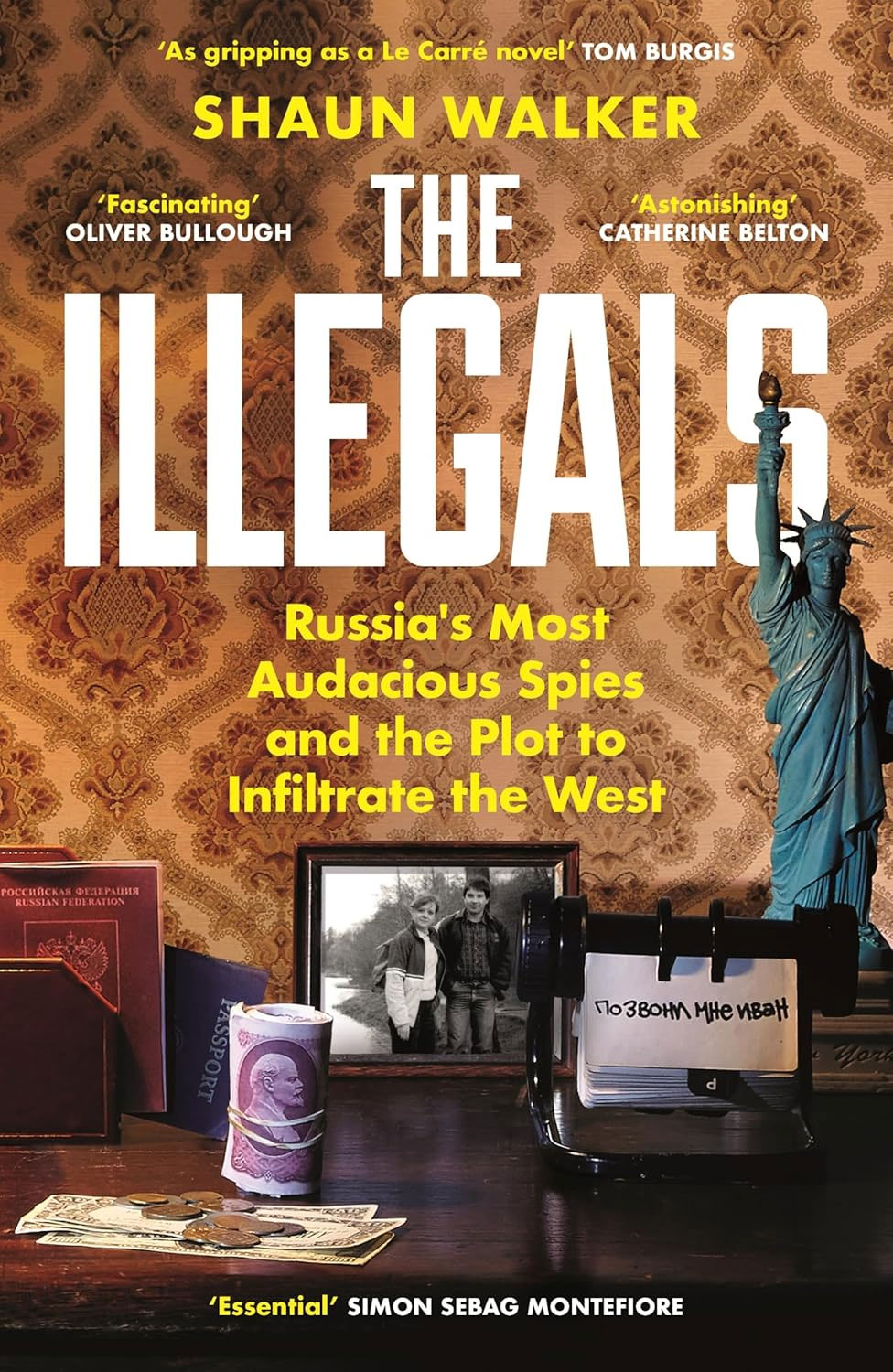
Shaun Walker’s new book The Illegals: Russia’s Most Audacious Spies and the Plot to Infiltrate the West presents the history of Russia’s deep cover spy programme from the ‘great illegals’ of the 1920s and 30s to the twenty first century when highly trained agents maintained false foreign identities and espionage activities beyond the fall of the Soviet Union. Walker, currently The Guardian’s central and Eastern Europe correspondent, previously spent more than a decade working as a journalist in Moscow. His book, he stated, examines both the ‘personal’ and ‘geopolitical’ history of the programme, weaving together personal stories of agents with political developments.
Walker came to the subject through the news of the arrest of two Russian spies, Elena Vavilova and Andrey Bezrukov, by the FBI in 2010. Their sons, aged 16 and 20, after their Canadian citizenship was revoked, brought and won a case against the Canadian government to reinstate their citizenship. The brothers had grown up with no knowledge that their parents, living under the aliases Tracey and Don, were not in fact Canadians but Russian spies.
In the 1920s and 30s, after the Bolshevik revolution, the now ruling party, with no formal foreign diplomatic relations or cemented control in many areas of Russia, deployed ‘the great illegals’ to gather intelligence. These agents were multilingual passionate communists formed from a core of the “conspiracy-minded” Bolshevik party and had often worked undercover pre-revolution. It is in this period, Walker described, that the most colourful and charismatic characters are found. ‘The Fast Flyer’ (real name Dmitry Bystrolyotov), posed as a Hungarian in London, charmed foreign office official Ernest Oldham and even had an affair with his wife. In exchange for envelopes of cash, Bystrolyotov obtained confidential British documents from Oldham. Oldham, however, eventually got ‘cold feet’ and then took his own life. The stories of these ‘great illegals’ conjure images of old school espionage reminiscent of film plots. But despite these somewhat fantastical tales, the outcome for many agents, Walker explained, was often far from glamorous. Many suffered from depression, having spent so many years isolated with no one knowing their true identity. Others were arrested and imprisoned on accusations of being double agents on their return to the Soviet Union by a “paranoid state” distrustful of even its most loyal followers.
After World War Two, the programme evolved as, with travel so tightly restricted, the Soviet Union was devoid of men like Dmitry who had developed multilingual skills and practice in taking on false identities in the pre-revolutionary period. Instead, agents were hand-picked from universities across the Soviet Union and spent 4 to 5 years training to take on new identities and conduct espionage. An exception to this less ‘flamboyant’ new generation, Walker noted, was the charismatic Iosif Grigulevich who posed as a Costa Rican businessman in Rome and the Vatican and eventually became the Costa Rican ambassador and concocted a (later called-off) plan to assassinate the Yugoslavian president Tito with a box of bubonic plague-infected chocolates!
One of those intensely trained to become an illegal was Yuri Lenov. Recruited at age 18, he was sent to Kiev after finishing university where he was not only trained in languages and foreign cultures, but it was also drilled into him that he must act with complete loyalty to the state. By this time, to counteract issues of loneliness and the pressures of deep cover work which had led to agents going mad, defecting and revealing their identities, the state was also now recruiting female illegals and matching them with agents in a system Walker wittingly labelled ‘KGB Tinder’. Under this system, Yuri was matched with Tamara. On their deep cover first mission, they were forced to leave their 6-month old child at home. Tamara struggled greatly and was eventually sent back to the Soviet Union. After this, Yuri only completed short trips under an Austrian identity, including to the Prague Spring when he posed as a pro-West capitalist.
In the story of Yuri and Tamara and the other illegals, Walker balanced descriptions of the more fantastical elements of their lives with a recognition that being in deep cover had profound psychological consequences for both illegals and their families.
The question that remains then, Walker outlined, is ‘Are there still illegals today?’. Yes, appears to be the answer, he explained, despite the massive cost and resources needed to deploy them and the unreliability of results. Most recently, in 2024, a Russian spy couple were arrested in Slovenia where they were posing as Argentinians. Their children were told only on the plane to Russia that they were not Argentinian but Russian.
Walker’s talk presented a fascinating history that is not only closely tied to the development of the Russian state over the last century but is a true human story filled with complex characters.
‘The Illegals: Russia’s Most Audacious Spies and the Plot to Infiltrate the West’ by Shaun Walker published by Profile Books
 LitFest ’25 – Andrew Miller – ‘The Land in Winter’


