




from Feb 10 – Jul 30
A new exhibition opening this week (Feb 10th) at Oxford’s Ashmolean Museum explores one of the most infamous of classical myths and celebrated stories of modern archaeology: the Labyrinth, the Minotaur (half-man, half-bull monster) and the Palace of Knossos. Featuring more than 200 objects, many on loan from Athens and Crete, the exhibition also offers a unique virtual tour of the Knossos Palace in the 5th century BCE as reimagined thanks to the digital recreation of the site in the Assassin’s Creed Odyssey video game. Ubisoft created the film especially for the exhibition to demonstrate the research behind the game. The exhibition runs until Jul 30. To book tickets click here.

In Greek myth the Labyrinth at Knossos held the Minotaur, a monstrous bull-human hybrid awaiting his sacrificial victims. The story remains one of the most enduring of classical myths and, unsurprisingly, Knossos is now one of the most visited archaeological sites in Greece.
The exhibition traces the story of the excavation of Knossos at Crete. For centuries, travellers searched the island for the mythical Labyrinth, leaving a trail of myths, misleading maps, and misread archaeological evidence until 1878 when the remains of an ancient building at Knossos were discovered by a Cretan businessman and scholar, Minos Kalokairinos. In 1900, it was the British archaeologist and Keeper (director) of the Ashmolean, Sir Arthur Evans (1851–1941), who was granted permission to dig there by the Cretan authorities.
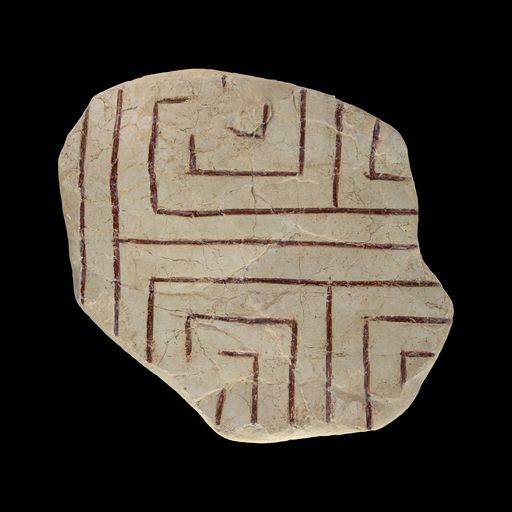
Evans was convinced that this building was the Labyrinth of myth. He rapidly found colourful frescoes, clay tablets showing an early system of writing and even a room with an intact stone throne on which he imagined the rulers sat. He referred to this labyrinthine building as the ‘Palace of Minos,’ and he was able to establish that it was around 4,000 years old and built during the Bronze Age. He popularised the term ‘Minoan’ to describe the civilisation of Crete in this period.
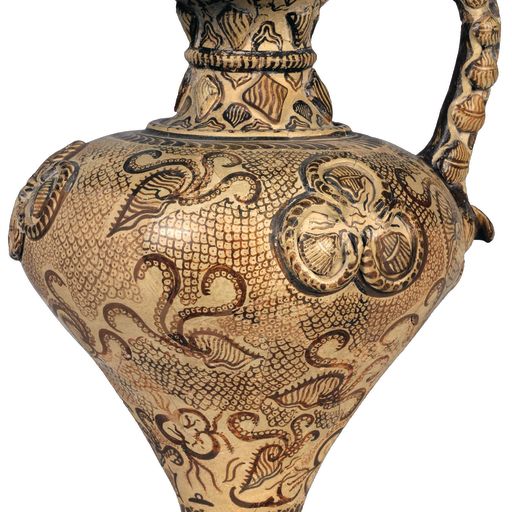
The exhibition features some of the finest Minoan objects that Evans uncovered, from everyday objects like decorated pottery to elaborate sculptures, many on loan from the Heraklion Archaeological Museum. They are reunited with drawings made during the excavation from the Ashmolean’s Sir Arthur Evans archive. Some of the drawings show the process of reconstructing the site and its finds, providing an insight into Evans’s controversial concrete restorations of the Palace of Minos.
One of the exhibition’s highlights is a finely carved marble triton shell, showing the skill of Minoan craftspeople and their particular interest in marine animals. Other objects show octopuses and argonauts in the depths of the sea, or depictions of bulls, sometimes with people leaping over them.
Evans saw in these the origin of the myth of the Minotaur: some Minoan seal-stones show how these images of bull-leaping could be condensed into the head of a bull and the legs of the leaper.
The final room of the exhibition displays discoveries made in the post-war period, and many recent finds. These include objects verifying Knossos as the site of the earliest known farming settlement in Europe, established in around 7000 BCE.
Among the recent finds on display is a spectacular Bronze Age dagger with inlaid gold and silver griffins, the first of its kind found on Crete. The exhibition ends with the chilling discovery, made in 1979, that appeared to show evidence of a ritual human sacrifice providing a tantalizing hint of the Minotaur myth.
Dr Xa Sturgis, Director of the Ashmolean Museum, says: “This is an exhibition that only the Ashmolean could mount. Since 1903, the Museum has held the largest and most significant collection of Minoan archaeology outside Crete thanks to one of my predecessors as Ashmolean Director, Sir Arthur Evans. Long thought of as an archaeological pioneer, Evans and his interventions at Knossos are now being reconsidered in their historical context. The exhibition offers both an exploration of Minoan culture and Greek myth, and a deeper look at British archaeological history.”
Travel from Marlborough by car to Redbridge Park and Ride takes around 45/50 minutes. Oxford museums have many free events in half-term including the One World Festival at the Ashmolean Museum on February 11 and 12, 2-4pm suitable for all ages; Ocean World at the Museum of Natural History where visitors can discover the underwater world of animal life and touch some real ocean specimens 11-12, 13th, 14th Feb, suitable for all ages; Lyra’s World, a display of objects from BBC adaptation of Philip Pullman’s ‘His Dark Materials’ on display at the History of Science Museum and Pitt Rivers Museum.
 Nick Fogg, confirmed as Mayor-to-be by Councillors at Extra-Ordinary meeting


