





 Outline planning permission for new housing development on land off Rabley Wood View was turned down by Wiltshire Councillors in August 2014. Next Thursday (September 17) the Eastern Planning Committee meets and those same councillors will decide on a slightly revised plan for this land – a scheme that is still hotly opposed by nearby residents and again has the backing of the Council’s planners.
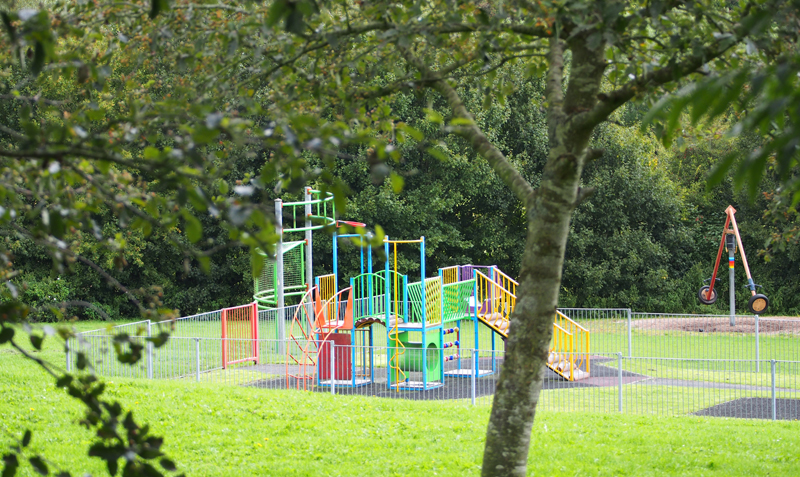
The houses will be built on amenity land which is now used as a play and sports area. And replacement land for that amenity area – or ‘compensatory open space’ – for various types of play area would be provided by the Sangster family’s Manton Estate mainly on the River Og water meadow.
The existing amenity land is owned by Wiltshire Council and one of the key complaints of local objectors is that when permission was given for the surrounding housing estate in the 1980s, this land was designated as an amenity area “in perpetuity”.
In the first dictionary of the English language, Dr Samuel Johnson defined ‘perpetuity’ as “Duration to all futurity” – language which may sound slightly odd to us, but which clearly carries the weight of ‘infinite time’. A more modern dictionary definition is simply ‘lasting forever’.
When the lawyers get their hands on ‘in perpetuity’ it means very much less than forever – generally in connection with inheritance cases. And when the planners get their hands on it Humpty Dumpty’s famous remarks on language come to mind:
“’When I use a word,’ Humpty Dumpty said in rather a scornful tone, ‘it means just what I choose it to mean — neither more nor less.’ ’The question is,’ said Alice, ‘whether you can make words mean so many different things.’”
When objector Jayne Baker pointed out that the amenity land was to remain an amenity ‘in perpetuity’, Wiltshire’s planners replied: “The conditions attached to previous planning permissions are designed to ensure that no change takes place without any such change being considered by the local planning authority in terms of a planning application.”
“If a subsequent planning application is brought forward many years later, a decision can be made that may supersede the conditions attached to previous planning decisions. The decision on whether such a change is appropriate in this case is one that will be made by Councillors on planning grounds in due course.”
This ability to ignore any ‘perpetuity’ provision is in fact enshrined in law: Section 106(A)(6) of the Town & Country Planning Act 1990.
So the use of ‘in perpetuity’ is at best a deception – relying on common usage to reassure people, while holding to a completely different and entirely flexible meaning of the phrase.
And this dubious use of the phrase makes one section of the planning officer’s report to be considered on September 17 open to serious questioning. While the Council’s ‘Open Space Officer’ approves of the compensatory open spaces outlined in the re-submitted outline plans, he is worried about ‘ongoing maintenance’:
“The developer will be expected to demonstrate to Wiltshire Council that adequate arrangements for the ongoing maintenance of recreational and amenity space associated with the development have been made, such provision will be required in perpetuity.”
 Rough Guide
Here is a ‘rough guide’ to the main issues that will be argued over by Wiltshire councillors next Thursday – some of these issues are very complex and this will be an abbreviated ‘rough guide’.
The number of houses has been reduced from 46 to 39. Wiltshire Council’s housing team want 40 per cent of the new homes to be affordable housing: “This would represent 16 of the proposed 39 homes: 12 should be for affordable rent and four for shared ownership.”
Marlborough Town Council has objected on the grounds of ‘highway safety, road access, nature conservation, traffic generation, layout of buildings and general safety issues with regard to children.’
Action for the River Kennet has objected mainly because the development would interfere with work ARK has done (funded by the government) on the River Og valley and in addition the plans involve draining water meadows.
The Wiltshire Council Archaeologist required a field evaluation of the site before planning permission is given. But planning officers have accepted that “that once a resolution for approval of the application is established, that this be made subject to a favourable outcome of the upfront field works considered necessary. Officers consider that this approach seems reasonable in the circumstances.”
The Campaign for the Preservation of Rural England does not object, but wants road improvements in the surrounding area. And Wiltshire Council Highways has tabled some small conditions and says: “The location is considered to be sustainable in transport terms…”
The Council’s Open Space Officer is happy with the ‘compensatory’ play areas. [See above re their maintenance.] However Sport England has lodged an objection – based on the loss of the informal playing field.
Twenty-seven ‘representations of objection’ have been made by nearby residents. These cover legalities, principle of development, highway matters, landscaping, recreation, amenity, flooding, contaminated land, ecology and five ‘other issues’. All the 42 points in these objections have been overturned by the planning officer.
Not mentioned in the planning officer’s report which the committee will discuss and rule on, are the safeguarding issues for children using the new play areas. These were part of the reason the committee found the development ‘unacceptable’ in August 2014: the play areas’ distance from houses mean a ‘lack of oversight’ and a ‘lack of natural surveillance’ which would require children to be supervised by adults.
Local objectors say that these highly important safeguarding points have not been addressed properly in the new plans. And they still want to know how safety of children can be guaranteed in an area used during the Second World War as a firing range.
Apart from the ‘in perpetuity’ issue discussed above, there is one other basic objection: it has been suggested that there is an implicit conflict of interest because Wiltshire Council will benefit financially from this development.
This is not simply a matter of the New Homes Bonus which means the Council will receive government money for six years for each of the new houses – that is true of all current new housing applications. Rather it is that the developer (the Sangster’s Manton Estate) will be paying Wiltshire Council to build the houses on Council owned land or will just buy the land from the Council. The developer will then sell the houses.
So far this allegation of a conflict of interest has not been answered fully either in response to specific objections from nearby residents or in the planning officer’s report to Wiltshire Council’s Eastern Planning Committee.
 Donations flood in for occupants of ‘Calais Jungle’


