





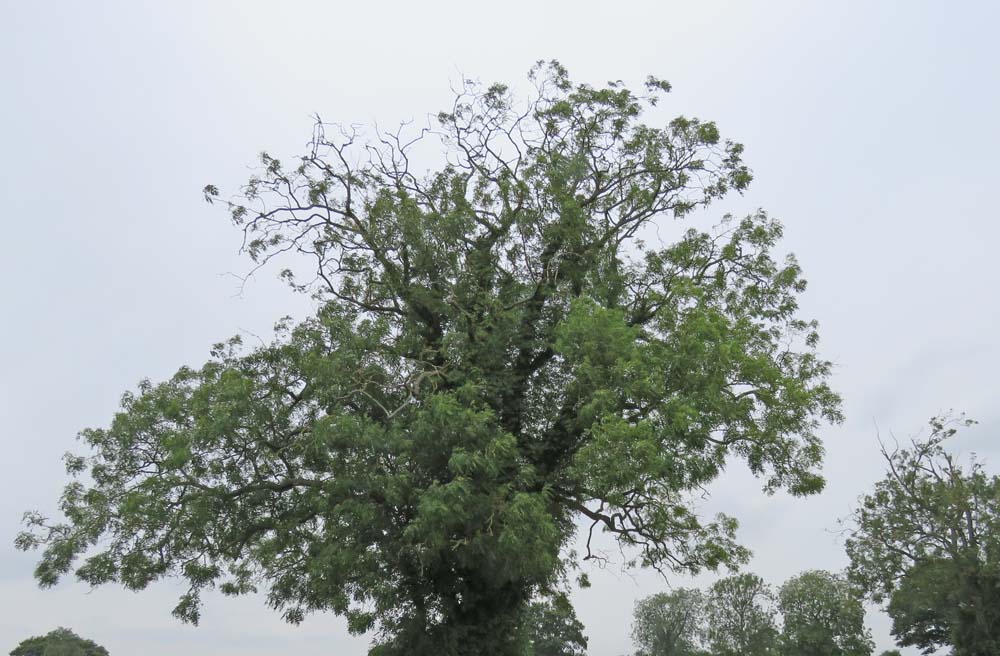
 In 2014, when the first signs of ash dieback disease were found in the south of England, marlborough.news reported that it had not yet been found in Wiltshire. Last summer we had to report that ash trees in Savernake Forest were ‘suffering widely’ from the disease – as confirmed by the Forestry Commission.
It is now all too apparent that the ash dieback disease has spread to other parts of the Marlborough area.
The disease is caused by the fungus Chalara fraxinea (now identified by scientists more accurately as Hymenoscyphus fraxineus). It blocks water transport within trees. This causes the tell-tale loss of leaves in a tree’s topmost branches. Other signs are lesions appearing on the bark.
In the end the whole crown of a tree ‘dies-back’ and as the wood becomes brittle, the tree becomes a danger. Some landowners and farmers are seeking to prevent accidents by cutting down ash trees close to buildings or beside roads. There have been some complaints from the public about the way some ash trees are being felled.
Marlborough.news has heard of two forestry workers who have been injured while felling diseased trees – caught out by the unusual behaviour of such brittle wood.
Marlborough Town Council looks after 1,500 trees on their open spaces. For risk management and insurance purposes, they have regular checks made by a professional arboriculturalist.
Their most recent inspection in February this year found no diseased ash trees in Marlborough and Manton – which is good news.
To give a wider view, we are publishing an article written by Alistair Ewing who is the Estate Manager for the Ramsbury Estates:
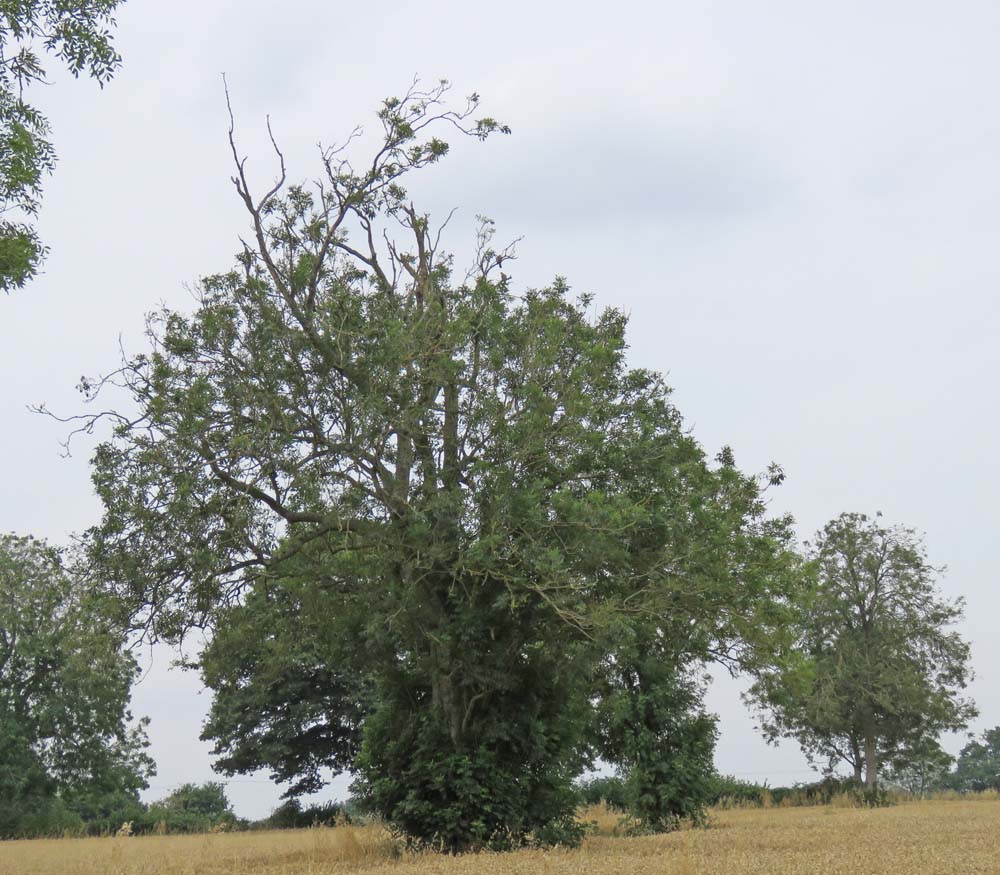 Some of you may have realised that our ash trees are under attack. The attacks come in the form of a fungus known as Chalara fraxinea (now identified as Hymenoscyphus fraxineus). The disease is commonly known as ‘ash dieback’.
The disease is spread when spores are released onto the leaf litter or are blown on the wind, as well as being spread on the feet of animals and walkers.
This disease is invariably fatal – not necessarily by itself, but it allows other pathogens to enter the tree which seal its fate. It is estimated by the Forestry Commission that between one and five per cent of our ash trees will show some tolerance to this disease.
There are an estimated 80 million mature ash trees in the UK or approximately 13 per cent of our broadleaf woodland trees.
Chalara was first identified in Poland in 1992 and possibly originated in Asia. Ever since, it has spread westwards. It was identified in the eastern counties of Norfolk and Suffolk in 2012.
England imports many thousands of young trees from nurseries in continental Europe and this is probably the source of our infection, although it cannot be ruled out that spores were windblown from the continent
I suppose you could blame globalisation for this affliction – as with Japanese Knotweed, Himalayan Balsam, Grey Squirrel, American Signal Crayfish, Mink and several other non-native species. Because we are an island, we have been a relatively secure country.
Now nature is encountering threats for which it has developed no evolutionary resistance.
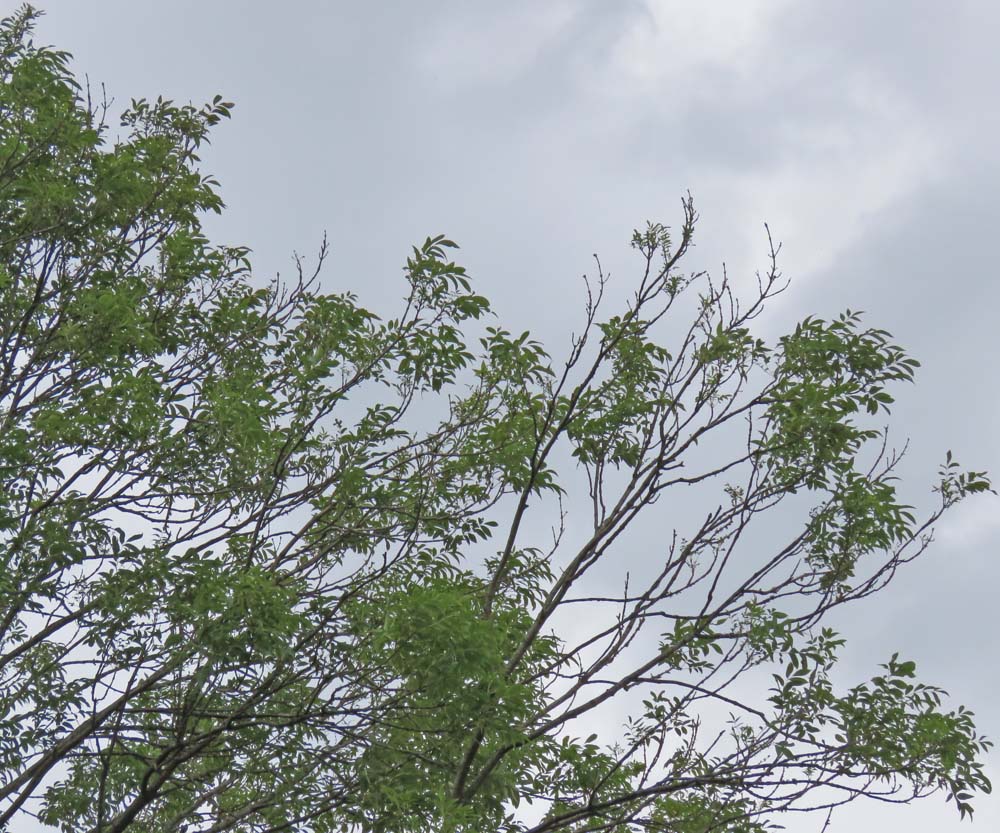 This disease is going to have a quite a devastating effect on our hedgerows and woodlands. Unlike Dutch Elm disease which wiped out virtually all the large and mature elms which were really confined to hedgerow and parkland trees.
A dead oak tree will possibly stay standing for ten, twenty or even thirty years before falling over, these Chalara affected ash trees will last a fraction of that. The onset of the disease coupled with other pathogens destroys the structural integrity of those trees which renders the wood very brittle in a short space of time.
This represents quite a danger to those working and walking in the woodlands.
We at the Ramsbury Estate have always had a proactive approach to managing our woodlands which is in line with Forestry Commission guidelines.
In the softwood plantations, we are felling Spruce, Larch, Corsican Pine and Douglas Fir in rotation when they reach maturity. We are replanting in the next planting season (Nov-March). This gives us a constant supply of mature timber, which goes to make window, frames, doors and items for the construction industry.
The first and second thinnings are used for fence posts, bars etc. The rest is chipped to feed our biomass boiler at the Ramsbury distillery.
On the broadleaf areas, which dominate our woodland ,trees are felled either because they have become dangerous, old and diseased or they are mature and can be used for all sorts of hardwood applications. The poor wood is destined for firewood.
Once trees have been felled, the areas are replanted with a mix of species - oak, beech, wild cherry, hornbeam, limes, walnut, hazel, field maple and occasionally crab apples or holly.
Because we are sequentially felling, over time the woodland becomes multi- aged with two hundred, one hundred and fifty, thirty year and possibly one or two year old trees in small parcels.
This mix of ages and species creates resilience in a woodland, which effectively does two things. It creates a very varied habitat for flora and fauna, invertebrates and the like. And if disease strikes – as in the case of Chalara – it will not destroy the whole woodland.
It seems rather poignant that in this centenary year of the creation of the Forestry Commission, United Kingdom woodlands face their most challenging and serious situation since its inception.
Born out of a desperate need to become more self-sufficient in timber, the Commission has been relatively successful. Centuries of building ships of the line, pit props for the mining industry, duck boards for the trenches in the Great War and many more uses led us to import 90 per cent of our timber even before the 1914 war. The U-boat menace put even more pressure on UK woodlands.
Under the Forestry Commission’s guidance the area of broadleaved woodland today is 80 per cent greater than the total woodland shown in the 1877 agricultural survey.
We ourselves have planted nearly 200 acres of new wood on former farmland over the last twenty years. If you combine that with re-stocking felled woodland areas it accounts for a few hundred thousand trees.
But ash dieback is here and we have to manage it. We are – and will be – leaving trees which show tolerance to the disease. Apparently UK ash trees have a more diverse genetic makeup than their continental cousins, so in time if there are fully resistant trees out there, and we may be able to plant ash again.
Our landscape will change in the short term, but I suppose that’s evolution The flora and fauna will adapt and hopefully people will take the long term view – a view that every forester has every day.
You can report outbreaks of ash dieback by phone to 0300 067 4000 or by email to tree_health_england@forestry.gsi.gov.uk
 Wiltshire’s new Primary Care Networks cost half-a-million pounds in consultants’ fees

