






 Marden boasts the country’s largest henge (* see below) and for the next six weeks the village will be home to a major archaeological dig over three sites. It is the first part of a three year programme led by the University of Reading with partners Historic England to uncover significant remains in the Vale of Pewsey that will help tell the story of Stonehenge and Avebury – and of the Vale itself.
Marden’s henge was twice the size of Avebury and about ten times the size of Stonehenge – and lay midway between the two. To the visitor there is not much left to see of Marden’s henge. It is true across the Vale that its rich soil has encouraged farming and the centuries of ploughing mean all the sites are now below the surface.
 Dr Leary told Marlborough News Online: “One of the many wonderful opportunities this excavation presents is to reveal the secret of the Vale itself. Communities throughout time settled and thrived there – a key aim of the dig is to further our understanding of how the use of the landscape evolved – from prehistory to history.”
It was on the rim of what is left of Marden’s inner henge that in 2010 Dr Tim Leary and his team discovered the remains of a late neolithic house – dubbed in the headlines ‘England’s oldest house’. It was probably not occupied as a house, but may have been a ‘sweat lodge’.
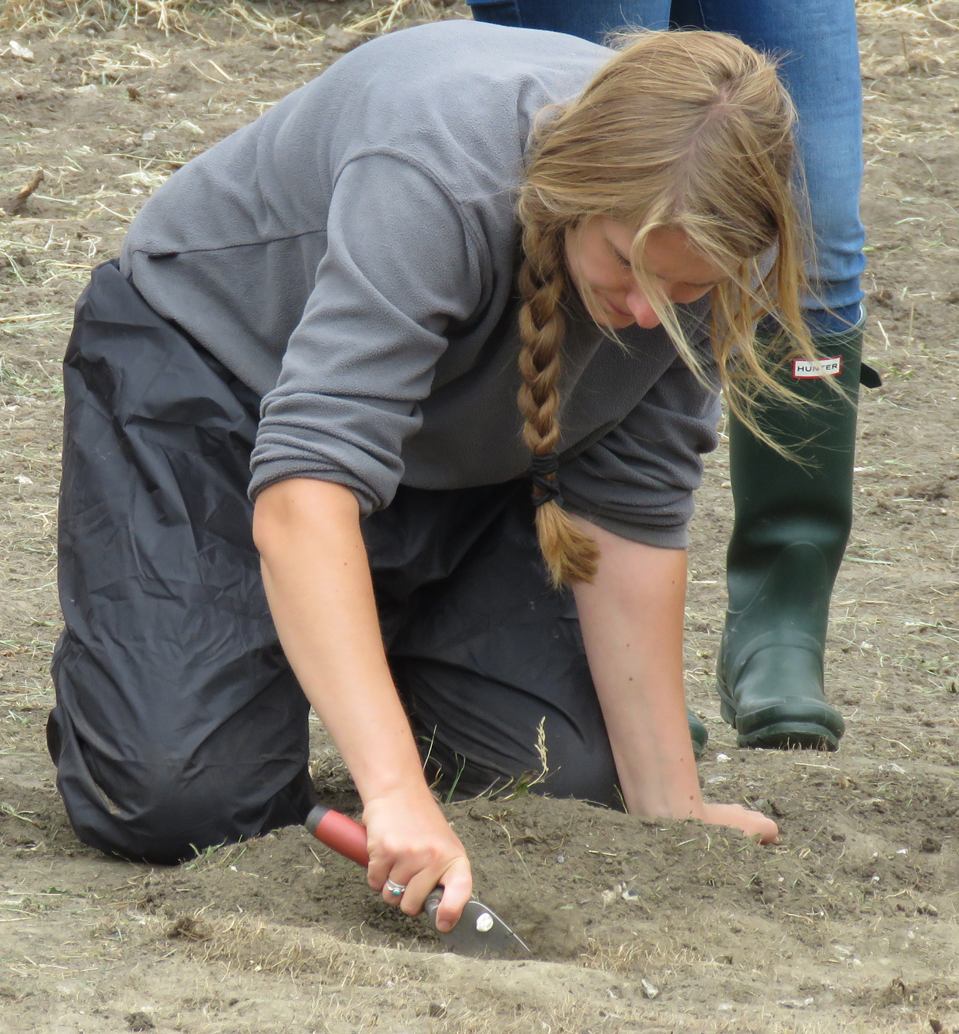 Now they are going to uncover that find again and dig further around it to find out more about it and the about the pig bones that were found nearby. Dr Leary believes the henges have a close connection with their nearby rivers and with feasting.
The extensive work at Marden this summer is being carried out by the Reading University Archaeological Field School – directed by Dr Leary. He led the explorations inside Silbury Hill in 2007 and also dated the Marlborough Mound – proving it to be the same age as Silbury.
There was a fifteen metre high mound at Marden, but it collapsed early in the nineteenth century, the remains were removed and it was then ploughed over by the farmer. In 2010 Dr Leary’s team found some remains of the mound – just fifteen centimetres high, but enough to provide datable material that proved it too was as old as Silbury.
 Beyond the south end of the henge are two other large sites. One is a very big Roman site and the crops and top soil have already been machined off, and work is getting underway with trowels.
Nearby is the other site which may yet prove the most intriguing of all. Geophysical surveys have shown the outline of a huge rectangular enclosure – about 100 metres long: “It is,” says Dr Leary, “a very rare monument type – it could have some sort of ceremonial use – even an early form of long barrow.”
 The crop and top soil has been machined off one end of the enclosure leaving a huge area to be dug in detail. Already Dr Leary has been able to see marks that could well be the walls of the enclosure. From its shape and size he believes it may pre-date the henges by a millennium or more – taking it back to early neolithic times and the earliest farmers.
They will put a trench across one of the walls: “We’ll be looking for artefacts – but especially organic remains for carbon dating – charcoal is ideal.” The students will be searching for signs of pits and post holes – although the enclosure is almost certainly too large to have been roofed.
This is a large and complex operation with temporary offices, stores, electrical generators, transport, carefully planned food from local suppliers, a camp at The Wooden Bridge pub – and lots and lots of wheelbarrows.
Some eighty students from Reading University will be joined by local volunteers and an international gathering of students and archaeologists. The students will have regular training sessions in Marden’s village hall.
 The digs have involved negotiations with Historic England (who look after the Marden site) and four landowners. In the fields where the digs and spoil heaps are crops have been bought from the farmers. And The Millstream – Marden’s well-known pub and restaurant – should be doing a good trade too.
Visitors are welcome at the site – every day except Fridays until July 25 – 10.00am to 5.00pm. And there will be family open days at the site on Saturday, July 4 and Saturday, July 18. As you go towards Marden from Woodborough, the site office is on your left before you reach the bridges and the pub. Wiltshire Museum in Devizes has a special exhibtion as part of the project: “Between Stonehenge and Avebury: Marden Henge and the Vale of Pewsey.” This includes finds from earlier excavations.
* “A henge is a roughly circular or oval-shaped flat area enclosed and delimited by a boundary earthwork – usually a ditch with an external bank. Most henges have either a single ditch or a pair of concentric ditches surrounding the central area.” [Click on photos to enlarge them.]


 Marlborough look to return to winning ways at Winsley on Saturday


