





 At the beginning of November 1918, the war was still having an enormous impact on everyday life in Marlborough. The Home Front remained a somewhat bureaucratic, mean and rationed place. In many Marlborough households it was still an anxious or a sad time.
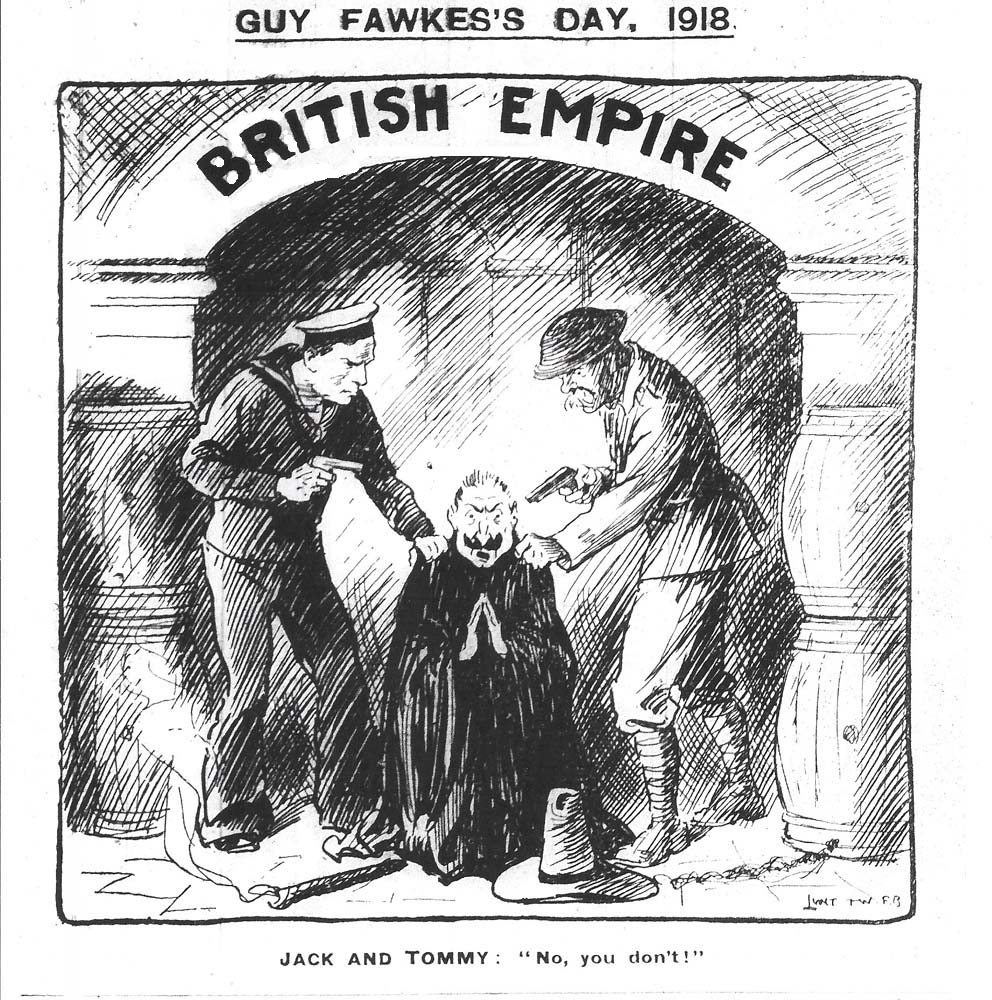
There were no bonfires or fireworks on November the Fifth. However, Guy Fawkes was enlisted in the patriotic struggle against The Kaiser’s Germany – as depicted in the Marlborough Times’ cartoon.
This was a propaganda message: our troops were defending the British Empire from the German Kaiser, who aimed to ‘blow-up’ the British Empire – with equal weight given to the Royal Navy’s often overlooked role in the war.
![Marlborough's new Mayor Councillor George Hughes [Photo courtesy Marlborough Town Council]](https://marlborough.news/wp-content/uploads/2018/10/G.H.HUGHES_MBORO_MAYOR_1918_jpg.jpg) Saturday, 9 November 1918 was a special day in Marlborough: the Borough’s new Mayor – Councillor George Hughes – was formally voted in and installed with all the traditional annual to-do that had survived through the war years.
Saturday, 9 November 1918 was a special day in Marlborough: the Borough’s new Mayor – Councillor George Hughes – was formally voted in and installed with all the traditional annual to-do that had survived through the war years.
Councillor Hughes was to have a history-making first few days as Mayor. Incidentally, November 9 was also the day that the Emperor of Germany, Kaiser Wilhelm II abdicated – although that news had not yet reached Marlborough.
During the ceremony one of the Town Councillors dwelt on the effects of the war, noting that it was the smallest attendance at such a momentous Council meeting that he had ever seen. Three Councillors were serving overseas in the armed forces and at least one other Councillor had been assigned to a distant wartime job.
After the ceremony Councillors discussed various matters of moment – including a proposal to ‘prepare a housing scheme’ to cope with ‘the serious shortage of house accommodation in the borough’.
There was mention of ‘the absolute scandal’ of conditions in which some people were living in Marlborough – even talk of ‘people with families compelled to live in slums in Marlborough’. The proposal to draw up a housing scheme was adopted.
The ceremony and business over councillors repaired to the Town Hall’s committee room for the Mayor’s ‘war-time luncheon’ – regrettably the menu was not divulged to the Marlborough Times.
However, we can learn a great deal about wartime life in Marlborough in those early days of winter 1918 from the fortnightly local newspaper – The Marlborough Times. Its masthead actually declared it to be the Wilts, Berks and Hants County Paper and Marlborough Times.
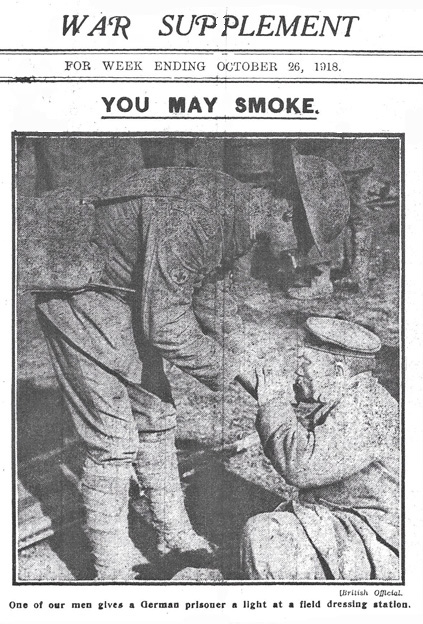
 During 1918 it had a regular four page War Supplement which carried a surprising number of photographs – all of them ‘official’ photographs that had been cleared by the censors and probably provided in printing plate form. The Supplement included a news in brief section headed “A Sheaf of War Stories”, as well as columns of “War Sketches”, “Food Topics” and “The Women’s Part”.
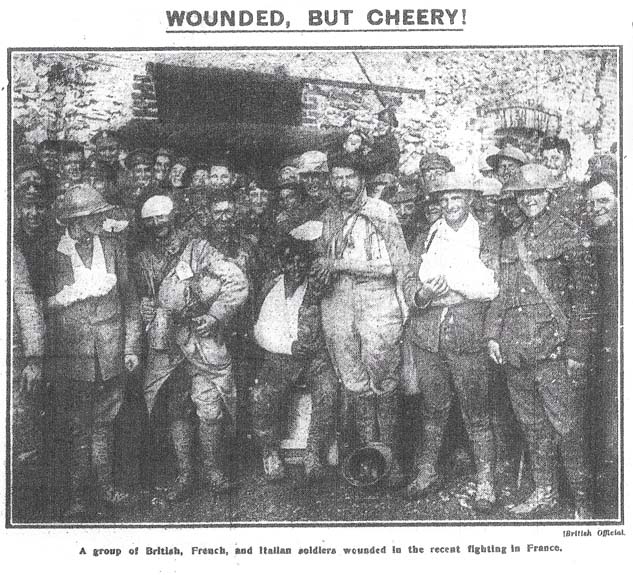
The paper was, of course, chock full of news of the fighting abroad and the austerity at home. As patriotism and censorship prescribed, it carried plenty of up-beat news and photographs. A photograph of allied and enemy soldiers at a field hospital was captioned: “Wounded but cheery”. And deeds of bravery and courage were given full coverage.
The reality of war broke through in the notices of those killed, wounded or taken prisoner. There was news of Sapper W.T. Dobson of Marlborough: “After a long period of suspense and anxiety, his wife has been told he’s a Prisoner of War in Germany. He was previously on the Italian Front.”
There is a tendency to believe the Great War was only fought on the Western Front. A surprising amount of space in the Marlborough Times was given to the other theatres of war – in 1918 these were mostly the Italian and Middle East campaigns. The headline: “Advance on Mosul Road – Close Pursuit of Turks” is quite striking.
That month the Marlborough Times included a report on hearings before the Marlborough Borough Tribunal for those needing exemption from conscription into the nation’s armed forces – it ‘proved to be the shortest sitting on record’.
 Among those appearing was Mr H.W. Irving aged 45 a ‘Grade 2, grocer – certified occupation’. He was given six months exemption from conscription – and was to be excused ‘the obligation to join the Volunteers’. But he told the tribunal “…he was already serving in the force, and did not wish to take advantage of the privilege offered him; he was willing to ‘carry on’.”
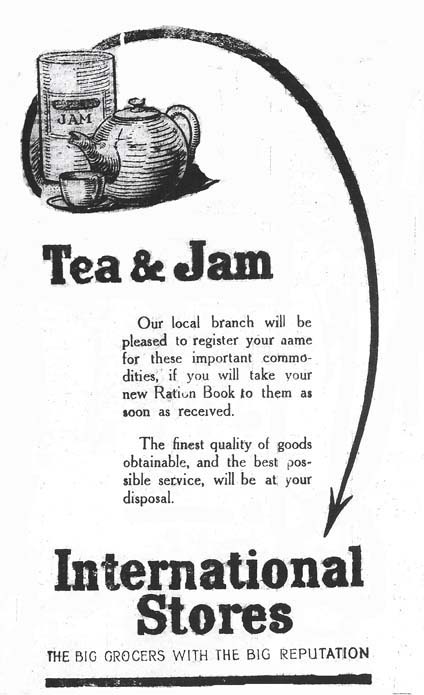
As the German blockade intensified, the coming winter had been regarded with some trepidation. As early as May 1918, Sir Arthur Lee, Conservative MP and Director-General of Food Production, was quoted in the Marlborough Times: “There’ll be less rations next winter unless women come to the rescue” – as farm workers.
A report in the newspaper stated: “The campaign to enrol women in the Land Army is making excellent progress, but it takes a lot of campaigning to get together 30,000 strong women fitted for the strain of harvest work.”
If the Mayoral ceremony had gone ahead paying little or no heed to the war, expectations of a traditional November 5 celebration had gone long ago. The Marlborough Times carried two advertisements for events to keep the minds of people – of varied musical tastes – away from war.
St Peter’s Church was holding an organ recital with vocalist Madame Joan Dalrymple – and a collection in aid of the local Voluntary Aid Detachment Hospital.
The other advertisement was a bit louder: “Hullo Marlborough!!! Please to remember the 5th of November. No fireworks, but Miss Rene Elsie is presenting her WEST-END COMPANY of ENTERTAINERS in BUBBLES – London’s brilliantly successful Music Entertainment – at the Town Hall. Numbered & reserved seats 3/3d and 2/3d. Unreserved 1/3d – including tax.”
 Councillor Hughes’ first weekend as Mayor ended with a service conducted by the Rector, Rev Charles D. Hoste, who had been appointed to the Marlborough Parish during the war, transferred from Yorkshire.
For his address the Rector chose a text clearly reflecting the feeling that the war was nearing its end – though of course unaware that it would end so soon: “He hath scattered the people that delight in war (Psalm lxvii)”.
“We meet this morning on an occasion which is fraught with all kinds of the most momentous issues. These days in November 1918 will be remembered in future generations, and here, this morning we are on the threshold of peace.”
Wartime or peacetime, some things continue on their way oblivious to wider events. A November issue of the Marlborough Times included a letter of complaint about a flooded footpath near the River Kennet: “There is – or was – a path running along the water meadow on the north side of the Kennet…it is almost completely inundated and is quite impassable for pedestrians…”
“Cannot something be done to remedy this state of affairs, and to allow natives of our town once more to enjoy these water meadows without discomfort.” It was signed “VIATOR” – a very old fashioned English word meaning ‘traveller’.
‘Discomfort’ was the sort of word used by British soldiers writing home about life in the trenches – with typical understatement. However, in the previous weeks, many of the Allied forces on the Western Front had left the trenches – and were now pushing the Germans back towards their borders.
This is the first of three marlborough.news articles using contemporary sources to depict Marlborough life at the time of the Armistice of 11 November 1918.


