





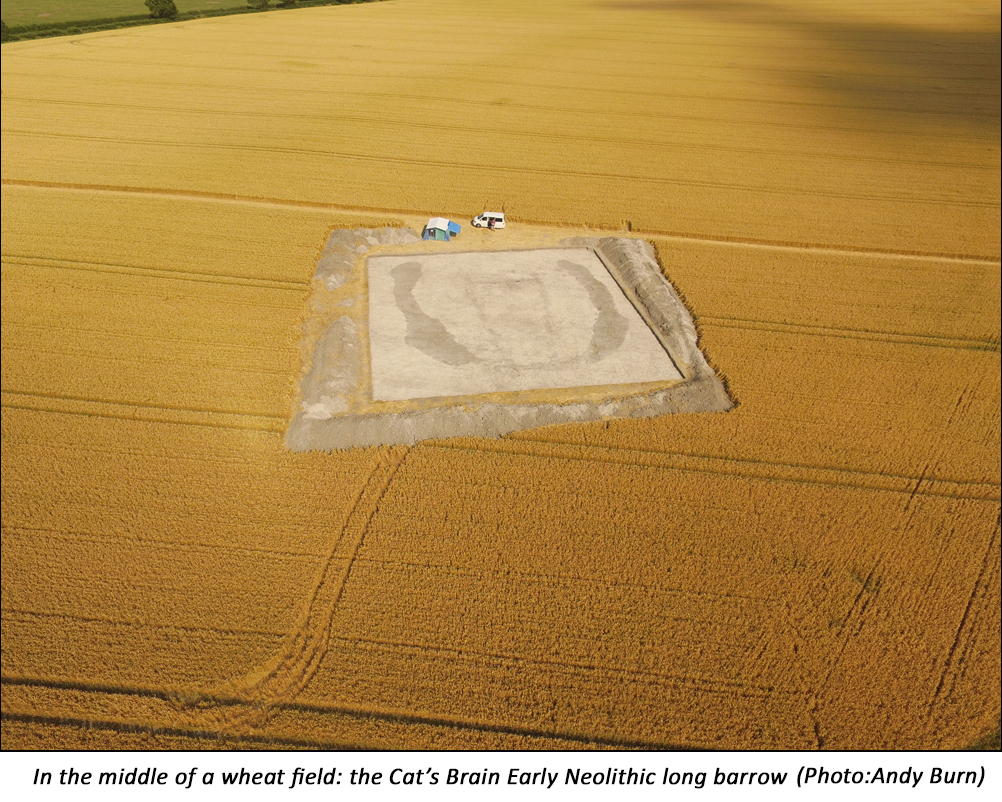
 A ‘House of the Dead’ has been discovered near Pewsey by University of Reading archaeologists and students. It dates back 5,000 years and could contain the ancestors of those who lived around Stonehenge and Avebury.
As part of the University’s final Archaeology Field School in the Pewsey Vale, students and staff, with the support of volunteers from the area, have investigated the site of a Neolithic long barrow burial mound in a place known as Cat’s Brain – the first long barrow to be fully investigated in Wiltshire in half a century.
The monument, which predates Marden Henge by over 1,000 years, may contain human remains buried there in around 3,600 BC. The outline was first spotted by aerial photography and confirmed by geophysical survey imagery.
As one member of the team explained: “The existence of a long barrow in Cat’s Brain has been known about for decades thanks to geophysical survey images, but finding remaining evidence of the building was a surprise, and finding human remains buried there would be a hugely unexpected bonus.”
An Open Day is being held at Marden Henge on Saturday, July 15 (details here) to allow members of the public to see the excavation happening live, as the team searches for human remains and artefacts.
 Dr Jim Leary, Director of the Archaeology Field School, is excited about the find: “Opportunities to fully investigate long barrows are virtually unknown in recent times, and this represents a fantastic chance to carefully excavate one using the very latest techniques and technology.”
“Members of the public now have the chance to visit us and see prehistory being unearthed as we search for human remains on the site. Discovering the buried remains of what could be the ancestors of those who built Stonehenge would be the cherry on the cake of an amazing project.”
The Cat’s Brain long barrow is a few miles from Marden. It is in the middle of a farmer’s field now growing a fast ripening crop of wheat – lying midway between Avebury and Stonehenge. It consists of two ditches flanking what appears to be a central building.
 This may have been covered with a mound made of the earth dug from the ditches, but has been ploughed flat over many centuries.
The monument dates to the early Neolithic period – an era representing the earliest agricultural communities in Britain, and the first monument builders.
Having cleared the top soil, the clear outline of the long barrow’s ditches is visible, as well as the footprint of the building. The team will now conclude the three-year Archaeology Field School project by excavating the archaeological remains and recover artefacts, bones, and other environmental evidence, which will be analysed.
This analysis will provide crucial evidence for the people and society in Britain during this remote period.
In addition to the Cat’s Brain long barrow site, the University of Reading’s Archaeology Field School is working at Marden Henge, the largest henge in the country, built around 2,400 BC, also within the Vale of Pewsey.
At Marden this year Dr Leary and Amanda Clarke’s 90 strong team of staff, students and volunteers have opened a trench through the south side of the mini-henge that lies within the main Marden Henge. The aim is to find remains of an earlier settlement that lies beneath the bank – of the same era as the house floor discovered in 2015.
 Little archaeological work has been carried out in the Vale, especially compared with the well-known nearby sites of Avebury and Stonehenge. The project aims to fill this gap in our knowledge and highlight the importance of the area in the Neolithic period.
Amanda Clarke, co-director of the Archaeology Field School: “This incredible discovery of one of the UK’s first monuments offers a rare glimpse into this important period in history. We are setting foot inside a significant building that has lain forgotten and hidden for thousands of years.”
The Pewsey Vale Project is in collaboration with Historic England, the Arts and Humanities Research Council and Wiltshire Museum. This is the final time the Field School will be held in the Vale of Pewsey before it moves on to Sonning in Berkshire in 2018.
You can watch a video of Dr Jim Leary’s explanation of the site here.
 Great Western Hospital gets some warnings of winter squalls to come

