





 Political parties urgently need to reform themselves to halt the growing disillusionment of voters, encourage young people in particular to vote and adopt new ways of policing errant MPs.
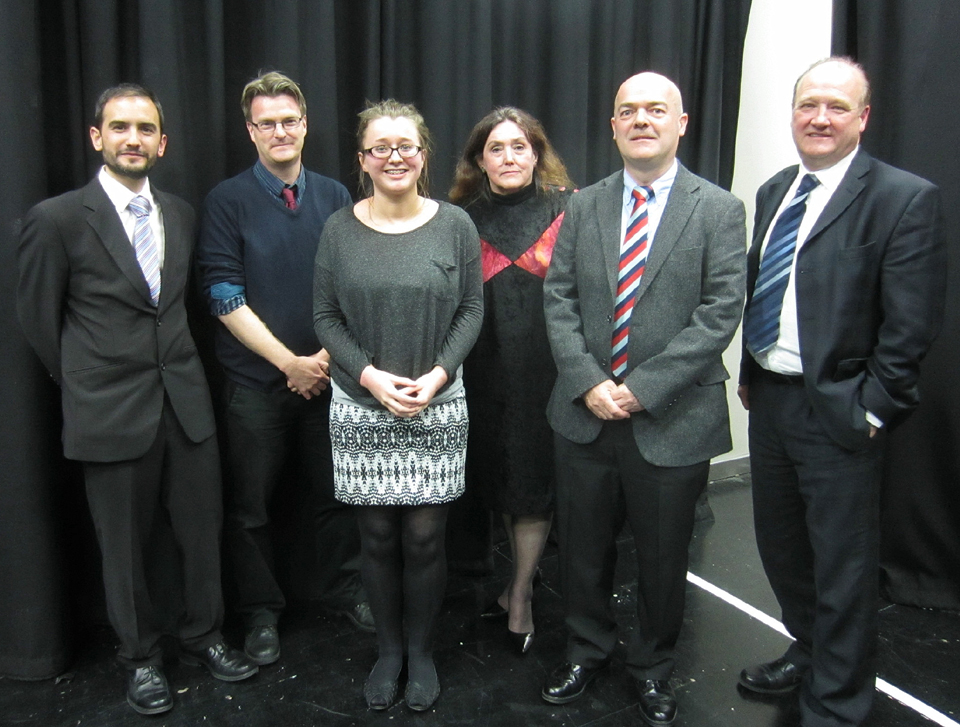
This was the passionate plea that came not only from the audience but also the politicians on stage at last night’s (Thursday) pre-election Question Time-style debate staged in the Theatre on the Hill at St John’s School, Marlborough.
Students studying politics at St John’s formed more than a third of the small audience of only 70 people, and their questions were given priority by Claire James, an Upper Sixth Form student who chaired the session.
They ranged over issues such as next month’s EU elections and the need for a referendum now, foodbanks and benefit changes, subsidised housing, compulsory voting and fracking to find new energy sources.
But the one question that took off – the audience included Richard Gamble, newly-elected chairman of Devizes Conservative Association, Devizes UKIP secretary Les Webster, Transition Marlborough activist Dr Sam Page and Marlborough town councillor Bryan Castle – was the lack of faith in the party political system.
And all the politicians on stage barring Green Party EU candidate Audaye Elesedy confessed there had been a failure to act.
Fiona Hornby, former Lib-Dem candidate for Devizes, demanded that radical changes were needed in the way democracy works in the UK to re-engage those who had become disillusioned.
“I am going to bang the drum about women in politics,” she declared. “Look at the make-up of the House of Commons, look at the number of women MPs, and look too at the number of women in company board rooms.
“If we had a more balanced society and a more balanced democracy, who knows what might happen. Why can’t MPs vote electronically? Why do they have to play sardines every night in order to vote?
“All that most people see on TV is a bawling match between several men shouting at each other every Wednesday. Why don’t we hold our PM properly to account? Why don’t we hold our council leaders properly to account with public meetings and public sessions where anybody can get up and talk about what is bothering them?”
But while young people had good reason to moan it was a two-way process. “You need to engage, to keep waving the flag for it to change and for it to be different,” she added amid applause.
David Pollitt, UKIP’s parliamentary Devizes candidate for next year’s general election, agreed that nothing much was being done to enthuse young people to vote.
“That stems from the fact that they have all these super-duper spin guys and election campaign experts who tell the parties that the young vote isn’t significant, that there aren’t enough of you willing to go out to vote to make a difference,” he explained.
“There is a far bigger percentage of pensioners who do go out to vote. That’s why they concentrate on them. If you were more active then the parties might spend more time courting you for your votes.”
And while he revealed that he didn’t know if his own 20-year-old university student son voted, his offspring had told him it would be against the Lib-Dems who gave him a £46,000 tuition fee debt.
Green Party EU election candidate Audaye Elesedy provided proof that his party was on the case with its own vibrant Young Greens movement and a campaign to elect 30 young people to local councils.
“And one of the key things we would do in government is to drop the voting age to 16,” he declared. “That is a crucial way to get more young people involved in politics.”
Swindon Labour councillor Chris Watts, due to stand for the Devizes seat next year, pointed out that the Labour manifesto also included votes for 16-year-olds but personally doubted whether that alone would encourage young people to vote.
“This school is quite lucky because you have politics as one of your options. Many schools don’t. Politics needs to be taught at a younger age.
“My daughter goes to a very good school in Swindon but quite sadly she hasn’t been taught anything at all about politics.”
He described Prime Minister’s Question Time as “an appalling display and a national embarrassment,” and added: “What we need to do is turn the House of Commons into a museum, move the politicians out of there and put them into a building that is fit for purpose and not something that looks like a game of British bulldog from the turn of the century with MPs waving papers and making funny noises at each other. It’s just ridiculous.”
And the fifth member of the panel, Wiltshire Tory councillor Philip Whithead, standing in for Devizes MP Claire Perry, also admitted that there was a basic problem that needed to be solved by political parties.
One of his daughters, educated at St John’s, went on to Exeter University, where she was elected to the Conservative Forward group, but although 1,000 students were politically motivated and involved contact between them was never organised.
“I berate the Conservative Party for not doing that,” he protested.
He denied as false any accusations that the public were denied access to Wiltshire Council decision-making meetings, at which anyone could raise their concerns, but, as far as Question Time in the Commons was concerned, that was a unique event envied by countries round the world.
“Nobody gets to question the French PM,” he declared. “Nobody gets to question the American president. So be careful we don’t throw the good out with the good and the bad out with the bad even if it is a bit rawcious at times.”
 Breaking news: St John’s School principal Patrick Hazlewood is to retire

