





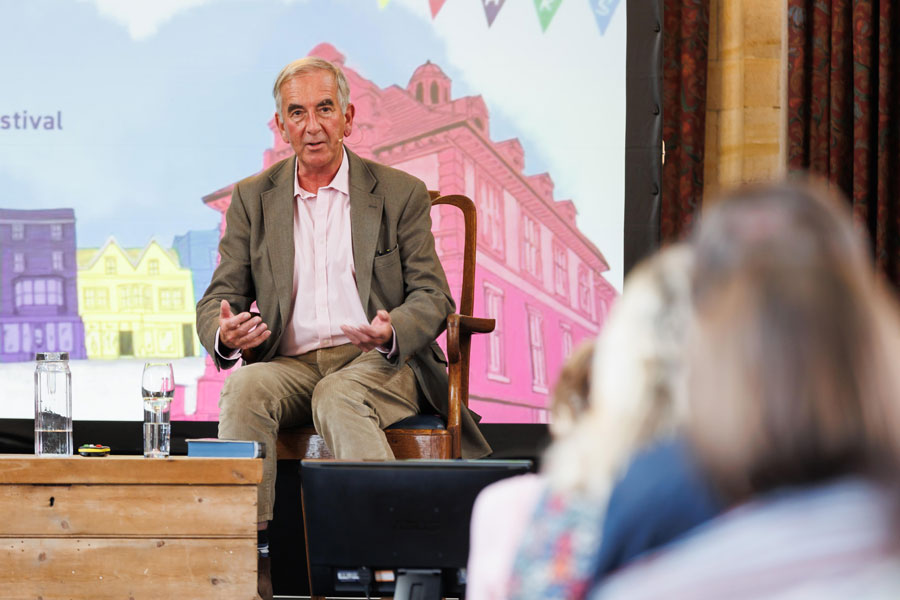
Marlborough LitFest was pleased to invite Robert Harris back for the second year running to speak about his new novel, Precipice. The novel is set in 1914 when, Harris explains, the whole world went over the precipice to war and the old Edwardian order was swept away. “Everything changed in 1914, it was the beginning of the modern world,” states Harris.
As with his other novels, this is his sixteenth, Harris weaves fact and fiction as he details the affair between Prime Minister HH Asquith (61) and socialite, Venetia Stanley, more than thirty years his junior and his daughter’s friend.
Harris based much of his research on the war time journals of Margot Asquith, which were published ten years ago, together with the letters Asquith wrote to Stanley. There are 560 letters, most written to Stanley during the 18-month affair from 1914 to 1915. Stanley was, says Harris, fascinated by politics, a free thinker and eccentric (she kept a pet bear and penguins). Sometimes Asquith was writing to her three times a day (the Edwardian post went 12 times a day) and he was sharing with her sensitive matters and papers of state. He was besotted with her and wanted her opinion on everything.
Using the letters, Harris is able to ensure Asquith’s words in the novel are his own. Harris commented, “This cache of source material was very useful – nothing is more interesting than real life.” Unfortunately, Asquith did not keep Stanley’s replies to his letters.
The novel revolves around the perspectives of three characters – Asquith and Stanley and the invented character of Paul Deemer, a policeman who is brought in to investigate drownings from a high society boat party trip on the Thames. Deemer is also called upon to investigate a leak of top-secret documents – highly classified telegrams that are found scattered across the countryside over the summer of 1914. Apparently Asquith had been throwing them from his car window to impress Stanley. “Politicians often do things that beggars belief!” commented Harris. Ironically it was Asquith who introduced the Official Secrets Act in 1911.
Other well-known figures also appear in the book – Churchill and Lloyd George. Harris conveys the political machinations of the time and notes that it was striking that no one knew war was about to break out. The focus had been on home rule for Ireland.
In 1915 Stanley looked for a way out of the relationship with Asquith and agrees to marry a man she didn’t really love. She finishes with Asquith just at the time he is facing the twin crises of the Dardanelles and the lack of shells on the Western front. He is forced to form a coalition government and there has never been a Liberal government since. Harris believes that Asquith may not have made this decision had Stanley not finished with him.
Harris investigates this important period of history and the themes of the novel explore class, power and secrecy as well as the role of a Prime Minister which Harris comments is relentless but “limited – it rarely goes on for long”.
 Katy Cawkwell at Marlborough LitFest