





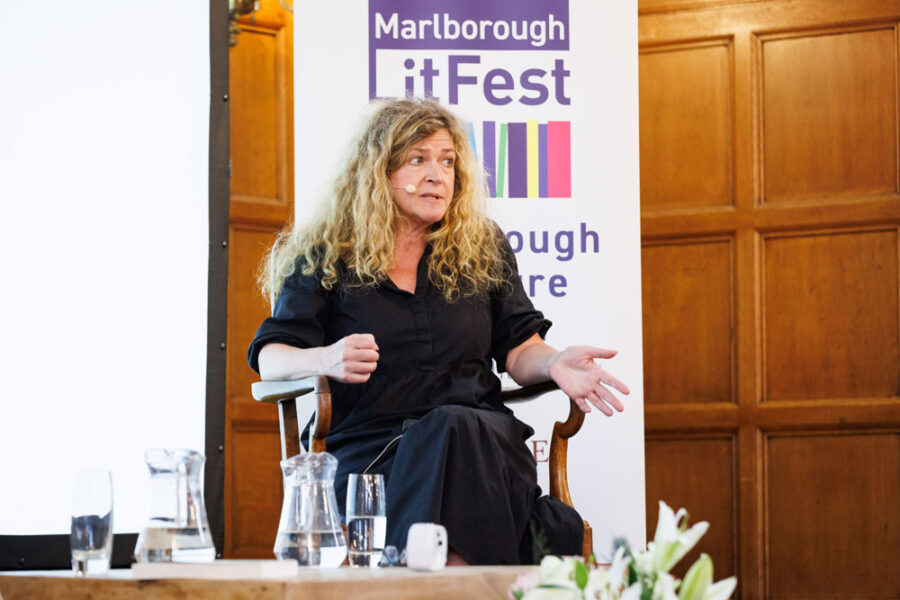
Kate Summerscale, bestselling author of The Suspicions of Mr Whicher, spoke to Marlborough Litfest audience about her new book for our anxious age, The Book of Phobias and Manias – A History of the world in 99 Obsessions. These obsessions range from the familiar, Arachnophobia, to the less familiar, Koumpounophobia (the fear of buttons) to the contemporary, Nomophobia (fear of being without a mobile phone). Summerscale wrote the book during the pandemic, “which was interesting as it was a time when we were all being made to fear things.”
Summerscale was invited to write the book by the Wellcome Collection. She started by reading case studies which revealed the moment psychiatrists identified a particular phobia or mania. “In Victorian and Edwardian England there was a real frenzy of identifying and studying phobias and manias. Many more have been found since. ‘Mania’ is an old fashioned term and now would more usually be seen as personality disorders or OCD(Obsessive Compulsive Disorder).”
A fear of flying is a common phobia and one that Summerscale shares. Unfortunately, “In the course of researching the book I imagined myself into more phobias -sidonglobophobia(fear of cotton wool) as well as a fear of buttons!”
According to Summerscale, “We all have fears so we are all on the phobia spectrum. Most people learn to live with their fear so phobias are under-reported. They are a normal part of childhood and women are twice as likely to have phobias than men.” This maybe, Summerscale suggests, because women are “more wired for caution in the evolutionary sense.”
Some phobias are considered cultural creations. The first documented account of Agoraphobia was in 1870 Berlin. It is however, Summerscale says, “a peculiarly modern condition relating to the man-made urban environment which can be geometric and alienating and cause individuals existential angst about being out in the streets in huge crowds.”
Another phobia considered to be a cultural creation is Kleptomania(stealing something you have no need of). This was first identified in the nineteenth century and was, says Summerscale, “a ‘get-out’ clause for affluent women who were shoplifting from the first department stores. It is now treated as an addictive disorder.”
Other manias described in the book include Monomania(a single delusional compulsion) popular in the nineteenth century. Mr Whicher feared he suffered from this. Monomania could also be seen in literature, for example, the character of Heathcliff.
Summerscale also discussed the role of Big Pharma in the medicalisation of phobias. There is a danger, she believes, that traits that were once described as eccentric foibles are now re-described and turned into illnesses for which you need drugs thus increasing profits of Big Pharma.
Summerscale loves research. She finds it “escapist and absorbing.” She has already started researching her next book. “I am drawn to the Victorians and I’m researching the Rillington Place murders which took place in 1953.” We look forward to its publication.
 Amanda Craig at Marlborough LitFest 2023


