





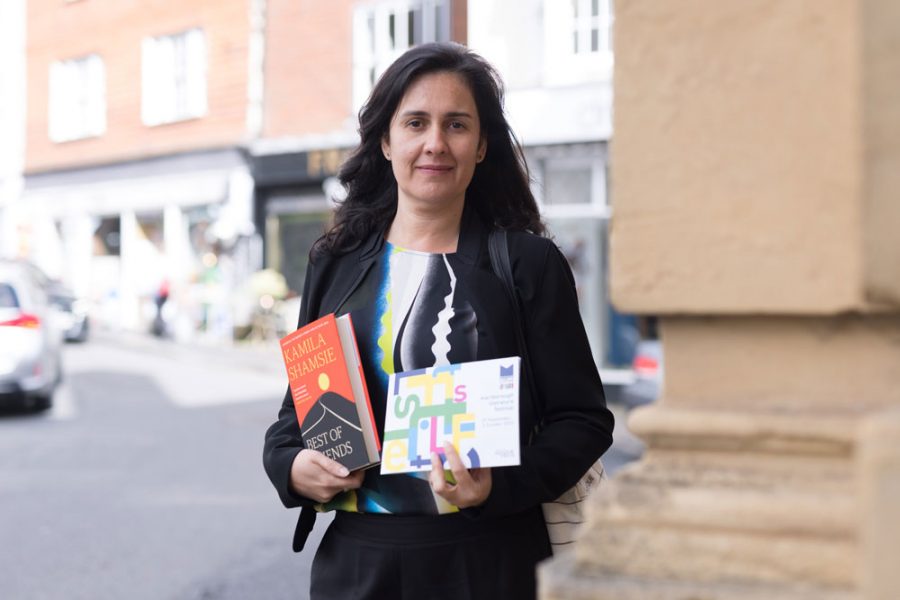
Five years ago Kamila Shamsie was at the Marlborough LitFest talking about her novel Home Fire. Today she returned to launch her new novel Best of Friends which will be published this week. It is her eighth novel. “I’ve written as many novels as England has had Henrys as kings!” she quipped.
The novel draws heavily on her own experience of growing up in Karachi in the 1980s and is full of historical, political and sociological insight. It traces the friendship of two girls, Zahra and Maryam, from their teenage years in Karachi in the 1980s to their adult lives in London. The novel, however, states Shamsie, “revisits adolescence rather than Karachi 1988 although the death of dictator President Mohammad Zia ul-Haq of Pakistan and the democratic elections which brought Benazir Bhutto to power were astonishing events to live through.”
Shamsie is “interested in early childhood friendships when you become friends before your character is defined and your value system formed. I wanted to explore that strange nature of the childhood friend, who if you met them for the first time in adult life, you wouldn’t be friends and you might not even like them. The way you see the world becomes increasingly divergent with the way they see it and yet the bond of friendship remains.”
Best of Friends explores the intensity of feelings felt as a teenager, of feeling awkward and working out what is and isn’t appropriate to feel, think and say. It also touches on class differences. Maryam is from an upper middle class privileged family while Zahra’s family is solidly middle class.
In the second half of the book the two friends have become very successful. Zahra, a former civil rights lawyer, is the head of an organisation for civil liberties while Maryam is a successful venture capitalist with a social media company who is beginning to understand how having a lot of money can give you access to political power.
The novel also explores the effect of social media on the very young which is particularly poignant given the Molly Russell case that has been in the press this week. Shamsie is also interested in exploring the idea of freedom. Her two characters argue about facial recognition technology. They have grown up in a surveillance state so is facial recognition technology surveillance or visibility as many people want to be seen, to have a public profile?
Finally, the novel also looks at the different ways you can be a migrant in London. But most of all the novel at its core explores the changing nature of friendship.
 Golding Speaker Ali Smith at Marlborough LitFest 2022