



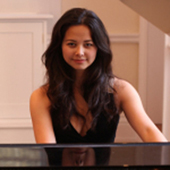
 The new season of recitals at Saint Peter’s church began (October 25) with a return visit to Marlborough by Mai Charissa Tran-Ringrose who first came to play for the Brandt Group Brilliant Young Pianists series three years ago. Mai Charissa was then aged 16, and now, aged 19, she is an undergraduate reading languages at Trinity College Cambridge.
In her short career as a pianist Mai Charissa won, aged 13, first prize in Thailand’s National Piano Competition for Young Pianists. At the same age she achieved the Diploma (with Distinction) of the Associated Board of the Royal Schools of Music, and a year later she was awarded its Licentiate. She has also been awarded the equivalent qualification in France: the Diploma d’Etudes Musicales.
The first half of her programme was devoted entirely to Beethoven – just two works, both in very sombre minor keys. First came the 32 Variations in C Minor. These toy variations, lasting in some cases but a few seconds each, were based on a simple eight-bar melody. There was a rich kaleidoscope of temperament in a very short time, some tempestuous, others placid, all rushing past the listener until Beethoven finally pauses for breath with the last dramatic and demanding variation. Mai-Charissa demonstrated not only her technical skills but also her ability to interpret each of these variations individually.
Beethoven’s Sonata 17 in D minor followed – another work in a dark key. It begins with a remarkable first movement, with a series of tempo changes that leaves the listener wondering what Beethoven was planning. The movement remains one of huge variations in mood: the fast sections are almost manic in intensity.
The second movement has a steady and persistent rhythm, the repeated chords in the bass creating the atmosphere of a funeral march. Relief finally arrives in the rippling and gentle allegretto movement, but even here the movement ends quietly with a profoundly melancholic theme which completes this troubling sonata.
We heard some technical skill here and Mai Charissa wrung from the work the dramatic mood changes and all-embracing sense of anguish which the work conveys.
Most of the second half was devoted to Chopin. Mai Chairissa began with two of Chopin’s Nocturnes, E Minor and B flat Minor – a form Chopin popularised. After the tempestuous Beethoven these were a good deal more calming. They are lyrical and wistful and very elegantly played.
 These were followed by Chopin’s Ballade in F Minor – another musical form which Chopin popularised. The name might suggest that there is a specific textual underlay; the telling of a story. There are pronounced shifts in mood, reflective passages which then lead into lighter dance-like moments, before ending in a dramatic and virtuosic outburst. Mai Charissa highlighted these mood changes in such a way that we could build up our own ‘ballad’ from the music.
The Chopin experience was briefly broken with the miniature ‘Smyrna’ which Edward Elgar had written in 1905 which visiting the eastern Mediterranean. This lovely work is very atmospheric, and the ‘colour and movement’ which Elgar describes is bedded deep in the left hand where there are traces of eastern harmonies and rhythms.
Finally the recital’s grande finale: Chopin’s Andante Spianato and Grande Polonaise Brillante – two wildly differing works which are frequently paired for their dramatic contrast. The Andante is gentle and has a very familiar lullaby feel to it – in complete contrast to the fireworks of the Grande Polonaise.
Yet another musical form popularised by Chopin, the ‘polonaise’ is loosely based on the rhythms of an energetic traditional Polish dance. This Polonaise, the most ambitious Chopin wrote, is joyful, full of wild rhythms and a sense of bravura leading towards a dramatic climax of arpeggios stretching the pianist to the limit, arms stretching the length of the keyboard and hands lost in an avalanche of notes.
What a performance! It was technically very good indeed and the appreciative audience greeted its conclusion with rapturous applause.
For a young pianist of but nineteen years Mai Charissa shows a very mature technical command of the piano. Perhaps her playing as yet, reflects too little of her own personality. Furthermore she should learn to engage more with her audience. However these are early days. After she completes her studies at Cambridge she plans to become an accountant. Nevertheless, let us hope that she will continue to play, for without her the world of music would be all the poorer.
For dcetails about future recitals in the series go to the MBG website – or follow our What’s On Calendar.
 Marlborough Rugby: Double header victory against locals rivals Devizes

