





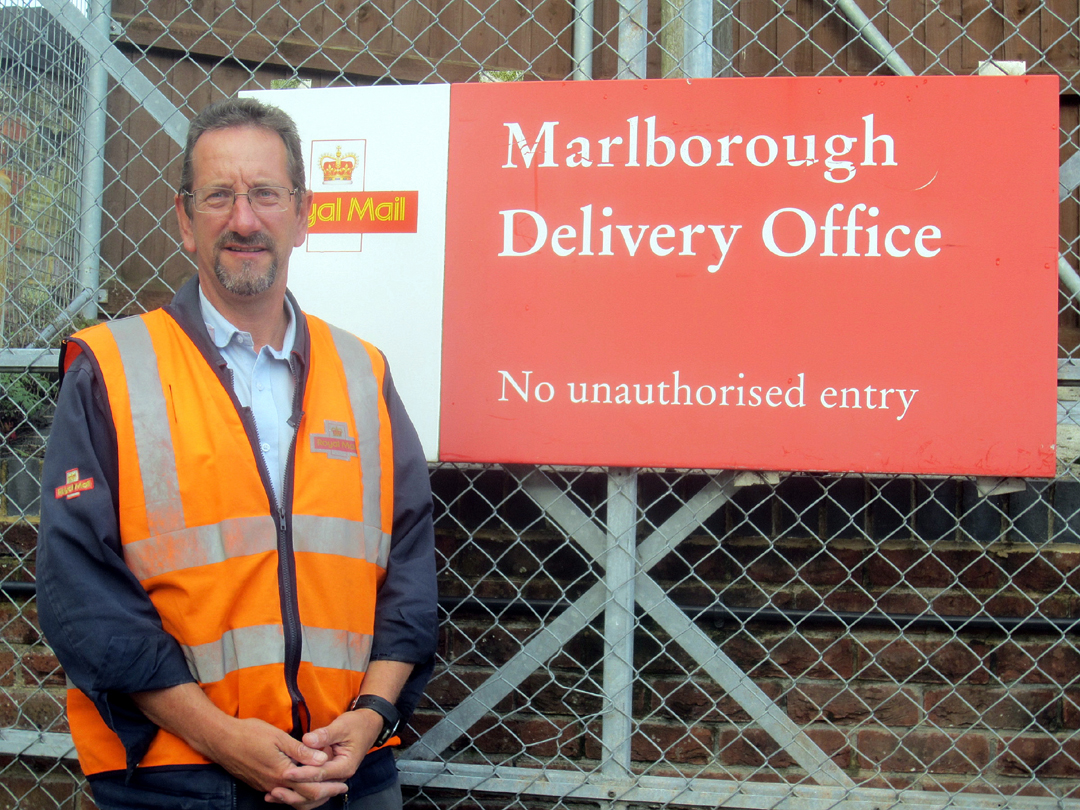
 With a strike ballot now imminent, Marlborough’s 65 postmen and women are facing the crunch decision how to vote now that the government has announced the £3 billion sell off of the world’s oldest postal service.
While former Prime Minister Margaret Thatcher refused to privatise “the Queen’s head”, the fears now of Labour politicians is that Royal Mail will inevitably fall into foreign hands.
And that a nationwide strike by Communication Works Union members – ballot result decision day is October 3 — will cripple the service in the run up to Christmas.
Royal Mail chief executive Moya Greene met 1,200 union representatives at a private meeting in Birmingham on Thursday after the government confirmed the floatation in the hope that a strike could be avoided.
Martin Tylee (pictured), the 57-year-old union representative at the Marlborough office, was among them, and on his return told Marlborough News Online: “The staff here were surprised to hear of the privatisation announcement but not of its content.
“They are supportive and I would hope that if we strike the majority of staff will support it.
“But there is a majority of staff who say they cannot afford to strike, although they should put their future and beliefs first before monetary loss.”
While Royal Mail staff are being offered shares worth £2,000 in the flotation, the underlying concern is that privatisation will lead to a two-tier system in which rural postmen will lose their jobs anyway.
“All we ask is that the government look at what the CWU is proposing,” said Mr Tylee. “We require a legally binding agreement covering a period of 10 years and that profit be invested back into the industry so we can modernise without seeking outside investment.
“The agreement will cover pay and conditions, a guarantee on pensions, protection of people’s contracts — no zero hours — and safeguards of jobs.
“Royal Mail have given false promises and not listened to reasonable arguments. We want to compete in the open market on a level playing field and deliver a universal delivery service six days a week to all 29 million addresses on a one price goes anywhere basis.”
He believes the Royal Mail belongs to the public and that it is up to the public to defend it by signing current petitions and protesting to their MPs, in this case Claire Perry, the Tory member for Devizes.
“The service under privatisation will be a two-tier system, more expensive and for rural areas will be very infrequent, say twice a week,” he warned.
“The postie will be a self-employed owner driver. There will be only an opportunity to earn a reasonable wage if he takes on a bigger round and rushes to do more and more. All contact will be minimal and they will cherry pick the profitable parts.
“So people in the cities and large towns will get a better service than their rural counterparts.”
|
TNT bid to blow a hole in Royal Mail sell off TNT, a major private parcels delivery business in the UK, is challenging the privatisation of Royal Mail in the High Court, the Sunday Telegraph reports today. It is questioning the 20 per cent VAT exemption Royal Mail receives as the “universal provider” of postal services in Britain and is going to the High Court on November 26 in an initial bid to challenge the exemption in the European courts. The VAT deal is part of a pan-European directive which allows tax breaks for universal service providers and if removed for new owners of Royal Mail would be added to the price of stamps and lucrative bulk mail services. “Having a privatised Royal Mail with a 20 per cent VAT advantage is simply not fair,” declares Nick Wells, chief executive of TNT Post UK. “We expect a favourable decision to come out of this process.” |


