






 For past two summers archaeologists have opened up the turf on Avebury’s West Kennet Avenue occupation site and dug down to find out more about the people who lived there in pre-historic times. The dig is part of the long-term ‘Between the Monuments’ project to find out about the people who made Avebury.
The archaeologists leading the project want to come back next summer to complete this part of the dig – but they are short of funds by a four-figure sum and want to the raise the extra through sponsorship and donations among the local community.
As reported by Marlborough News Online, the digs in 2013 and 2014 have been successful and some startling finds have been made. The site was partially explored by Alexander Keiller in 1934, but despite its importance had not been investigated since then.
One of the archaeologists, Dr Josh Pollard, explains: “In contrast to the record of funerary and ceremonial monuments, well preserved Neolithic and Early Bronze Age (c.3800-1500BC) settlements are exceptionally rare in southern Britain, and especially so on the chalk lands of Wessex…It seems as though we know more about the dead and religious beliefs of these communities than we do of their daily life.”
The site has not been disturbed by ploughing and may even have the remains of elusive Neolithic domestic structures. Next summer’s three week dig will complete the examination of one trench opened by previously and open one new trench.
This will provide good experience for students from the Universities of Leicester and Southampton, as well as suitably experienced local volunteers.
 One money-raiser for next summer’s dig will be the One-day Affordable Art Fair which three Marlborough Open Studios artists are holding at Avebury’s Social Centre this Saturday (November 15) between 10.00am and 4.00pm.
Jane Brunning, who will be selling her work at the fair, explained her interest in the digs: “I am a very enthusiastic supporter of our finding out more about our forebears who lived and worked in our local landscape. This is a very exciting search for knowledge of the Neolithic and Bronze age activity here in Avebury.”
It is known that there was a Saxon village at Avebury – now beneath the National Trust car park. And that the Romans had a considerable settlement just across the A4 from Silbury Hill. Finding out where and how the people who made Avebury lived and worked, will provide an essential part of the jigsaw of our ancestors’ lives and the landscape we have inherited.
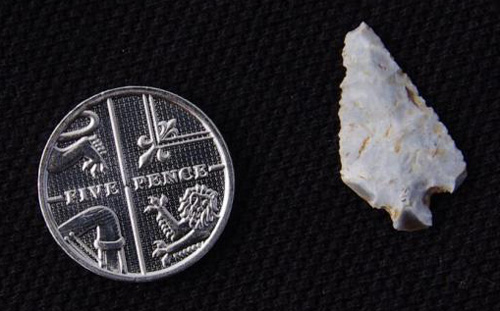
The finds made so far during the West Kennet Avenue digs give tantalizing glimpses of the people who lived in the area and created the stone circle, the henge and the avenues. This exquisite miniature arrowhead (photo below) gives rise to so many questions about these people – was it an adornment, a toy, an apprentice’s practice piece or simply a treasured gift? Without this third year of excavation we might never know what else lies beneath.
 Pewsey Vale’s giant pylons are on the shortlist for removal


